
Hey there everyone! Welcome back to Movie Soapbox, the little corner of the internet that only you and I and that one guy in the back who never takes his coat off actually know about. This is where we dig out the underseen, the undersold, and the philosophically bruising, and we make sense of them together. Today we are doing a full deep dive on The Music of Chance, a 1993 film so genuinely, structurally, intentionally strange that most people who stumble across it at 1 a.m. assume they missed something, when actually they got exactly what the movie intended to give them, which is nothing you can hold, and everything you can feel.
Before we go any further, everything from this point on is spoilers. The whole movie. The ending, the loop, the boulder, all of it. If you haven’t seen The Music of Chance yet, go find it, come back, and we’ll be here. The movie is thirty years old and it deserves your full attention before I take it apart in front of you.
Good. Now let’s talk about what this film actually is, because there’s a version of this story where it gets made correctly and nobody ever hears about it again. A Spader vehicle with a literary pedigree, a small budget, and a premise that actively refuses to pay off in any way a test-screening audience would recognize as satisfying, that is a film that gets a new third act, a cleaner ending, a score that tells you how to feel. It gets Stockholmed into something manageable. The fact that Philip Haas held the line on Paul Auster’s novel and delivered a film that ends the way it ends, with Jim bloodied and stumbling out to the road in a direct mirror of how it began, with zero resolution and zero apology, tells you something about how rarely the people financing a film and the person making it want the same thing. At this budget tier, with this cast, the director usually gets one real fight. Haas apparently spent his on the ending. Good. The right call.
Now. What actually happens in this movie.
The Music of Chance Crazy Movie Walkthrough
Jim Nashe, played by Mandy Patinkin, is a former Boston firefighter who inherited some money and has been driving around America ever since, going nowhere in particular, which is a behavior the film presents without judgment because the film doesn’t judge anything. He picks up Jack Pozzi, played by James Spader, on the side of a road, beaten up and broke. Jack is a card player, a grifter, a guy who reads situations and bets on them, and he has just been robbed of money he needed for a high-stakes game he was absolutely certain he could win. Jim, being either generous or reckless or both, puts up the cash to get Jack into the game.
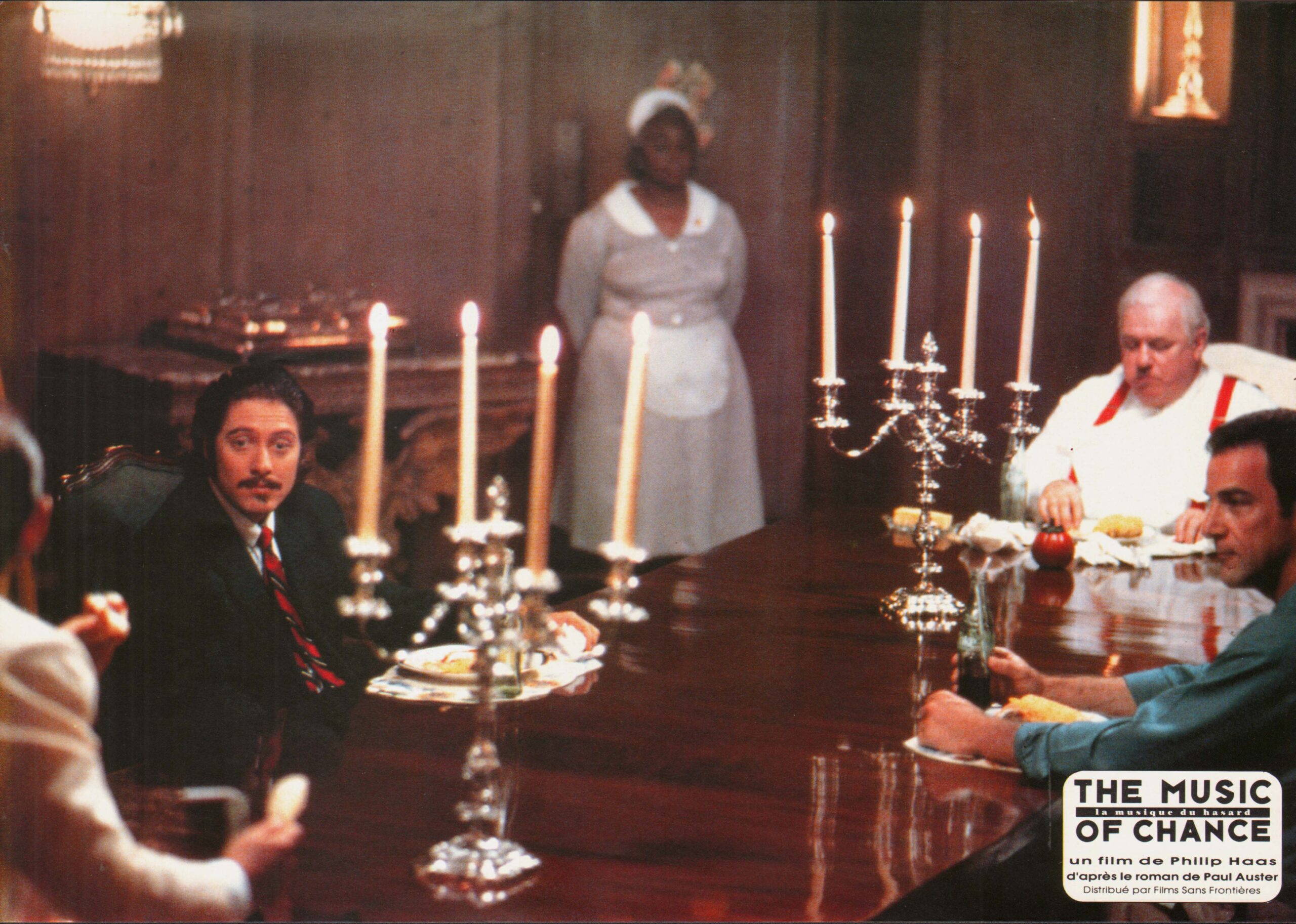
The game is at the estate of Willie Stone and Calvin Flower, two lottery winners turned eccentric millionaires living in a house that feels like it was designed by someone who read about the concept of wealth in a magazine. Stone is the quiet one. Flower is the one with the miniature diorama, an elaborate scale model of their lives, their history, their property, and now, after a brief inspection of their guests, their two new visitors rendered in miniature as well. Jack finds this charming. Jim finds it unsettling. Jim is right.
The poker game starts and Jack is electric, up big, reading the table the way he always does. Then Jim wanders off to look at the model again, takes what the film generously calls a nap, and while he’s gone the cards turn completely against Jack. Jim, in his fog, pocketed the miniature figures of himself and Jack from the model. He will later cite this as the reason the luck turned. The film does not tell you whether he is correct. The film does not tell you anything.
By the end of the night Jim’s car is gone, they are both in debt to Stone and Flower for a figure they cannot possibly pay, and the millionaires have a solution. They recently purchased the stones of a fifteenth-century Scottish castle, shipped them over, and they want a wall built in the meadow. A decorative wall. A wall that goes nowhere and encloses nothing. Jack and Jim will build it, live in a trailer on the property, work off the debt, and then they will be free to go.
The wall takes months. The film watches them build it the way you’d watch a man push a boulder uphill if you already knew what was at the top. Then, when the wall is finished and they’ve celebrated with a party and a hired woman named Tiffany played by Samantha Mathis, they are informed that the food they ate during their stay was not included in the arrangement. They owe more. They cannot leave.
Jack digs under the fence and runs. He is found the next morning, unconscious in the meadow, beaten. The overseer Walsh drives him to the hospital and leaves him there. Jim is not allowed to go. A while later Walsh tells Jack he’s been discharged, Jack understanding clearly that this means Jack is dead. Jim finishes his obligation, gets his freedom, goes out for a beer with Walsh and Walsh’s son, asks to drive his old BMW home that night, drives it too fast, swerves, crashes. Walsh and his son do not appear to survive. Jim staggers out to the road, bloodied, and a driver pulls over to pick him up.
The same image the film opened on. The loop closes. The boulder rolls back down.
The Music of Chance Movie Making of
Now. Why does any of this happen the way it happens, and what are you supposed to do with the fact that it doesn’t quite cohere as a story in any conventional sense.
The film is based on Paul Auster’s 1990 novel, and Auster was working squarely in the tradition of literary absurdism, a tradition that does not build toward revelation because its entire philosophical argument is that there is no revelation coming, the universe is not organized around your need for one, and the appropriate response to that fact is not despair but a kind of defiant, clear-eyed continuation anyway. Albert Camus laid the architecture. Auster applied it to American drift and American poker and American millionaires with too much money and too much time and a particular cruelty that looks exactly like benevolence from the outside.
The Music of Chance Movie Theories Explained
The three readings people reach for with this film are worth laying out because they’re all available and they’re all partially right, which is the point.
The Music of Chance Explained Theory Number 1
The first reading is economic and political. Flower and Stone are capital. Jack and Jim are labor. The wall is work that produces nothing of value for the people doing it, generates only obligation and extension of obligation, and is framed as opportunity by the people who benefit from it. Under this reading the film is a fairly direct allegory about how the working class gets recruited into debts they did not fully understand and works them off in service of a finished product that means nothing to them. The tiny red wagon hauling fifteenth-century castle stones across a meadow is either the funniest or the most depressing image in the film depending on your mood.
The Music of Chance Explained Theory Number 2
The second reading is mythological. The wall is Sisyphus’s boulder. The task is perpetual because it is designed to be perpetual, the additional debt at the end is not a surprise or a betrayal, it is the boulder rolling back down, the mechanism resetting, the punishment continuing because the punishment is the point. Jim and Jack didn’t lose a poker game, they got drafted into a cosmological structure that was never going to let them out. Stone and Flower are not villains in this reading, they are simply the form the universe took on a particular night in Pennsylvania.
The Music of Chance Explained Theory Number 3
The third reading is structural and purely absurdist, which means it refuses the allegory entirely. Nothing in this story is a symbol for anything else. Jack and Jim make a choice, the choice has consequences, the consequences metastasize in ways no one planned or intended, and the ending is the ending because all endings are just the moment you stop watching a loop that was already running before you arrived and continues after you leave. The circular structure, opening image echoed exactly in closing image, is Auster saying there is no arc. There is only the revolution.
I’ve given this particular question a lot of thought… but I definitely am in the camp of the second theory – the mythological reading of the film. The Sisyphus parallel is too precise to be accidental and Auster was too well-read to stumble into it, but I don’t think the myth is the film’s subject, I think it’s the film’s proof. Camus wrote that we must imagine Sisyphus happy. The boulder is not the tragedy. The belief that there should be no boulder is the tragedy. Jim crashes the car because he has been released from the wall and he still doesn’t know what to do with forward motion. He drives too fast for the same reason he picked up a stranger on the side of a road and handed him his last real asset, because in a determineless system the only move available is the next one, and the next one, and the one after that, and at some point you stop asking where the road is going.
The wall gets finished. The debt doesn’t. That’s not a plot hole, that’s the film’s entire argument in two sentences.
What Haas made here is a film that studio arithmetic could not have produced and did not produce, a small, cold, philosophically committed adaptation of a novel that was never going to generate a franchise, made with actors who were interesting enough to sell it without softening it, and finished in a way that refuses every instinct a distributor has about what audiences will tolerate. Thirty years later it is still sitting here, still asking you the same question it always was, and still declining to answer it on your behalf. Most films that survive their own making don’t get to keep that. This one did. That’s the thing worth holding onto.
We’ll see you next time at Movie Soapbox. Stay curious, stay skeptical, and for the love of everything, stop mistaking a wall for a destination.