
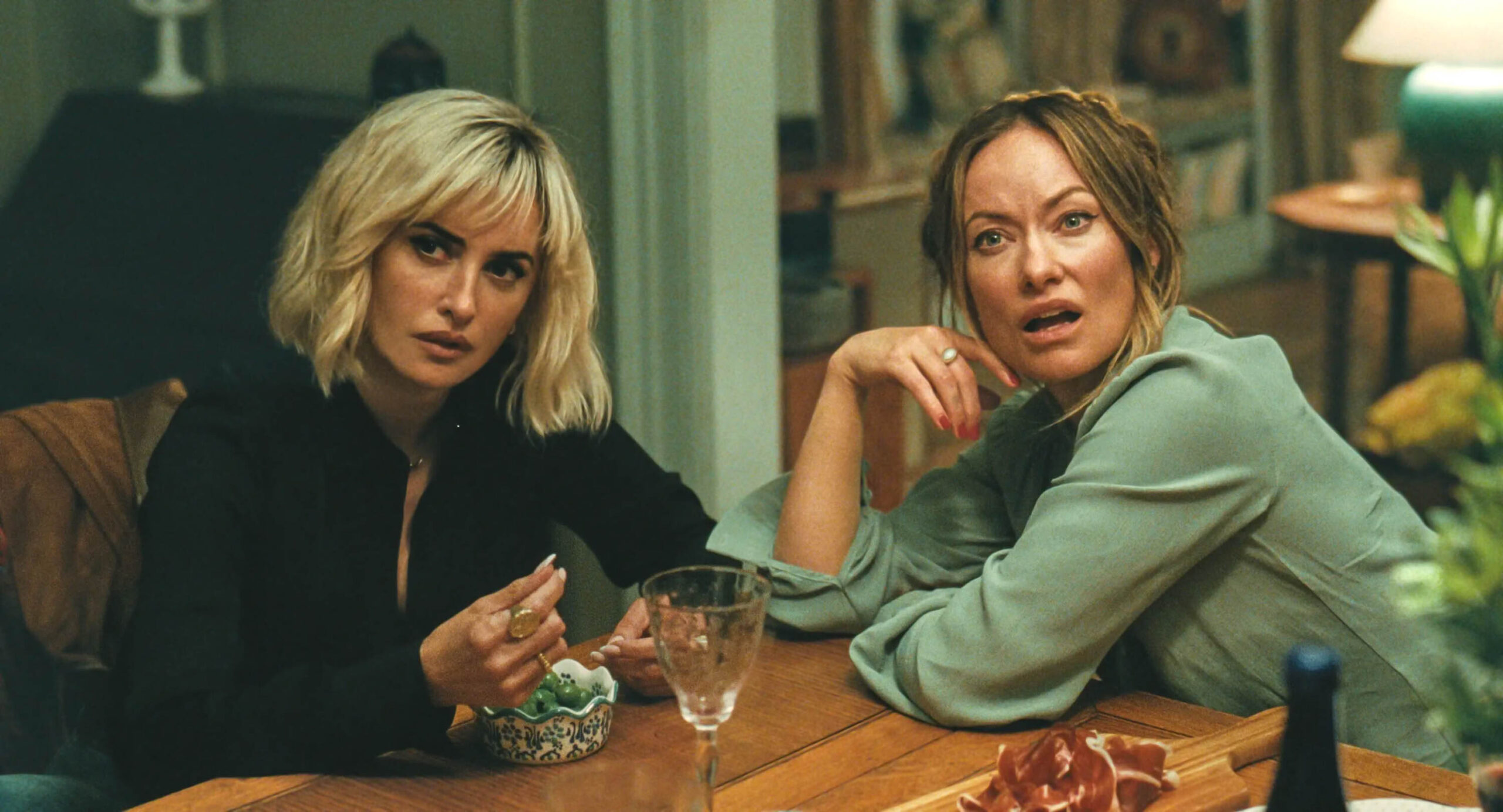
Movie Mike here. Everybody’s talking about The Invite right now — the dinner party comedy that had Sundance in a bidding war back in January and finally hit theaters this summer via A24. And look, the movie itself is great, my colleague already broke that down over on the main site. But what I can’t stop thinking about is how this thing actually got made, because the behind-the-scenes story is arguably wilder than anything that happens on screen. So let’s get into it.
It started as a role Olivia Wilde turned down
Here’s a detail most of the coverage is skipping: Wilde wasn’t originally attached to direct The Invite at all. She came to the project first as an actress, being considered for the role that eventually became Penélope Cruz’s character. It wasn’t the right fit for her as a performer — by her own account, it was a very different version of the character at that stage — but the project stuck with her. What hooked her wasn’t the role, it was the source material’s pedigree: this script traces back to a 2020 Spanish film (released internationally as The People Upstairs, though it’s known as Sentimental in Spain), which itself started as a stage play written and directed by Cesc Gay. That original film has since been remade across half a dozen countries — Italy, Switzerland, France, South Korea all have their own versions. Wilde has said that any premise that keeps getting reinvented across cultures like that must be tapping into something universal, and that’s what pulled her toward directing an English-language version rather than just acting in it.
American screenwriters Rashida Jones and Will McCormack wrote that English-language draft. Wilde signed on to direct in early 2025.
The two-week workshop that rewrote the script
This is the part of the story that actually explains why the movie feels the way it does. Two weeks before filming started, Wilde brought her four leads — herself, Seth Rogen, Penélope Cruz, and Edward Norton — into a room with Jones and McCormack, and they tore the script apart together. Not notes-and-polish. A full re-working, built out of improvisation and, by Wilde’s account, some genuinely uncomfortable personal disclosure — the cast ended up talking through their own definitions of healthy and unhealthy relationships to figure out how these characters would actually behave. That kind of process only works with the right group of people in the room, and Wilde has been pretty open that this cast was unusually willing to go there.
Fun wrinkle: there was originally a different actress attached to play Angela before Wilde stepped into the role herself, late in preproduction, at the urging of Rogen and Norton. By her own telling, that decision came together close to the wire — director casting herself in the lead of her own film, days before they needed to lock it in.
Shot in 23 days, in order, on real film — and she paid for the film stock herself
This is the detail that made me sit up. Most movies shoot wildly out of sequence and get stitched together in the edit. The Invite was shot in chronological order, start to finish, over 23 days, entirely on 35mm film. Wilde has talked about how big a deal that was creatively — shooting on film raises the cost of every single take, which raises the stakes for everyone on set, which she says sharpened focus and performance in a way that wouldn’t have happened shooting cheap and infinite digital takes.
And here’s the kicker: multiple outlets have now confirmed Wilde paid for that film stock out of her own pocket. She’s said flatly that she’s “a big proponent of shooting on film” and was determined enough to make this movie that way that she covered the cost herself rather than let the budget conversation kill the format. That’s not a small gesture on an indie-budget dinner party movie — film stock isn’t cheap, and this is a director putting her own money into a specific aesthetic choice most executives would have talked her out of.
Because they shot in order, the cast and crew could keep evolving the film during production, not just in that initial two-week workshop. Wilde has pointed to two specific moments as proof this paid off:
- Cruz’s Sade scene. Midway through the shoot, Cruz came to Wilde with an idea that wasn’t in the script at all — that her character’s seduction of Joe should involve music, specifically Sade, with Piña singing to him. It’s a big swing that only made sense because Cruz had spent two weeks in the character by that point and understood exactly how she’d play the moment. Wilde used it.
- Norton’s improvised monologue. Late in the shoot, Norton told Wilde he had a story to explain why his character goes by the name “Hawk” — but asked her not to let him tell her ahead of time, so she’d be hearing it fresh on camera, same as the audience eventually would. He performed roughly eight minutes of improvised backstory. About two minutes of it made the final cut. Wilde has said she doesn’t know another director who would have said yes to shooting it blind like that.
The ending of the film — which plays out almost entirely without dialogue — was something Wilde and Rogen kept reworking up until the last possible moment, and by her account it only became clear once they’d shot everything else and realized the characters had nothing left to say out loud.
The apartment was designed like a puzzle
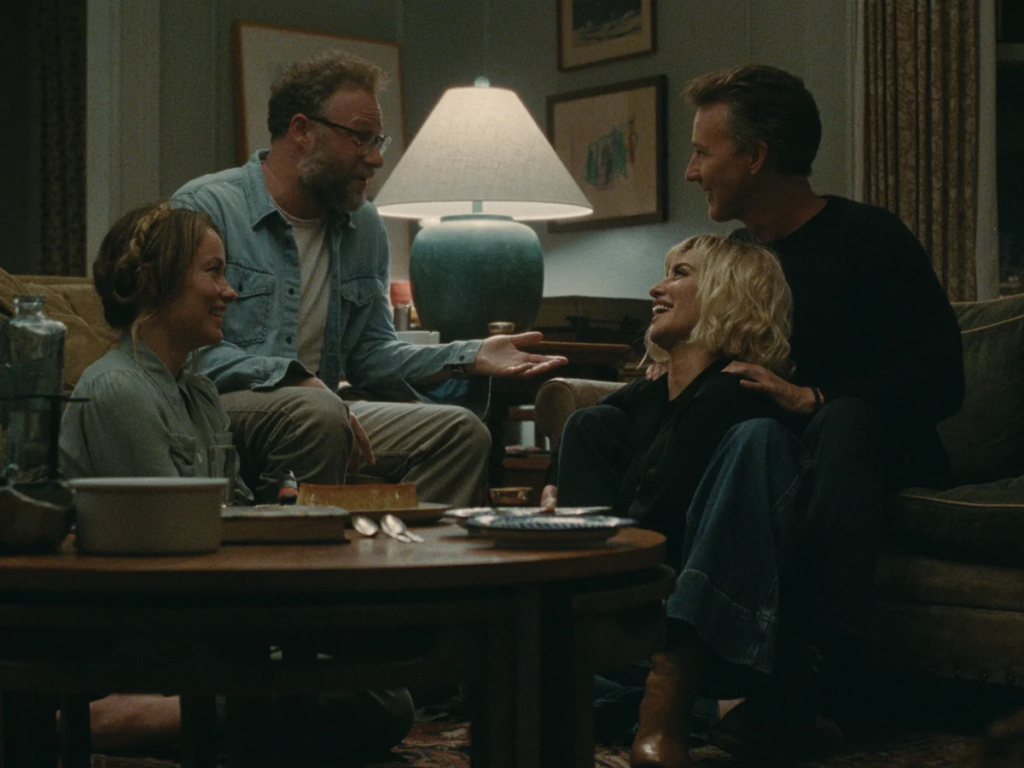
The whole film takes place in one apartment set, and that was a deliberate creative constraint, not a budget shortcut. Wilde worked with production designer Jade Healy and cinematographer Adam Newport-Berra (who also shot Rogen’s Apple TV series The Studio) to build a specific visual language before they ever started shooting: frames within frames, mirrors that let characters share a room without making eye contact, glass and walls used as literal barriers between people who are already emotionally walled off from each other — and then those barriers get slowly stripped away as the night goes on. Wilde has cited Amour as a reference point for what a confined, stage-built apartment can do, and Hannah and Her Sisters — specifically that kitchen-doorway scene with Carrie Fisher and Dianne Wiest — as an influence on how doorways and overheard conversations get used throughout.
She turned down Netflix for this
Before A24 won the Sundance bidding war, Netflix was reportedly in the mix and offering more money. Wilde has said the decision to go theatrical instead was non-negotiable for her, and that Annapurna’s Megan Ellison backed her on it despite the bigger check being on the table elsewhere. Wilde’s stated reasoning: this is a movie built on unspoken tension and glances, and she doesn’t think that plays if half the audience has a phone in their hand. A24 ultimately paid around $12 million for distribution rights out of Sundance.
There’s a bit of an industry subtext here too — comedies have been quietly getting pushed to streaming for the last few years, and Wilde has been vocal that she thinks that trend is bad for the genre and hopes it’s on its way out.
The Studio connection is not a coincidence
If you watched Rogen’s Apple TV show The Studio this past year, you might remember Wilde showing up playing a satirical, unhinged version of herself. That wasn’t just a fun cameo — Wilde has described it as a genuine creative reset after a few quiet years post-Don’t Worry Darling, and it’s directly where she connected with Newport-Berra, whose camera work on that show convinced her he was the right cinematographer for The Invite. She brought his entire camera crew over to this project as a result.
The score is doing something weird on purpose
Composer Devonté Hynes (Dev Hynes / Blood Orange) scored the film entirely on cello — an unusual, dramatic choice for something billed as a comedy. It’s aggressive early in the film in a way that’s clearly intentional: Wilde wanted the tension in the score to be doing real work, not just sitting underneath the jokes.
Small stuff worth knowing
- The film is dedicated to Diane Keaton, who died in October 2025.
- Two of Wilde’s on-camera breaks (her actually cracking up mid-take) both happened during Seth Rogen improv jokes, and both takes made the final cut because there wasn’t a usable alternate.
- The movie premiered at Sundance in January to a standing ovation and immediately became one of the festival’s hottest sales titles, with A24, Netflix, Neon, Focus, Searchlight, and others reportedly in the bidding.
Is this actually an Oscar movie?
I’ll leave the full verdict to my colleague’s review, but on the making-of side: this has the ingredients of a real awards-season player, not a lock, but a legitimate contender. Cruz is the name coming up most in early Best Supporting Actress conversation, and there’s real chatter about multiple nominations for the film once the fall festival crush clears out and voters start paying attention. Whether any of that materializes is anyone’s guess this early — but for a movie that started as a two-week script rewrite in a room full of actors confessing their relationship histories to each other, “Oscar contender” is a pretty wild place to land.
More on this one soon — I’ve got thoughts on the score I didn’t have room for here.