
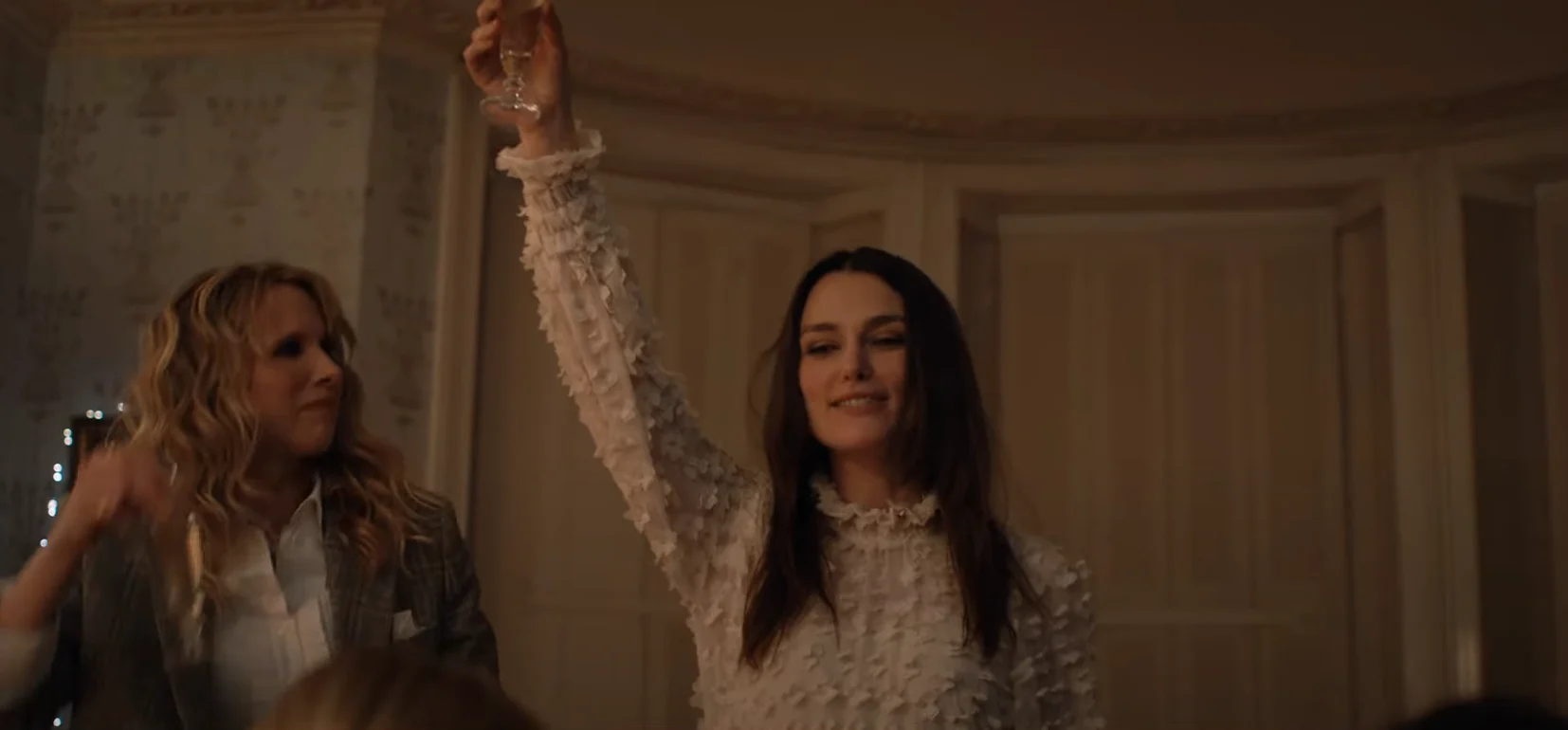
Hey there everyone! Welcome back to Movie Soapbox, the little corner of the internet that only you and I and that guy sleeping in the corner over there know about. This is the place where we find underappreciated indie films and we make sense of them. Today? We are doing a deep dive on Silent Night, a movie so quietly furious at the human race that it dressed itself up as a Christmas film just to get you to let your guard down before it kicks you in the teeth.
Alright, before we go any further, you should know that everything from this point forward is a spoiler. The whole film. The ending, the twist, the thing that makes you sit there with the credits rolling and genuinely rethink what you just watched. If you haven’t seen Silent Night yet, go watch it, come back, and then we’ll talk. It’s on streaming. It’ll take you ninety minutes. The film has already decided it doesn’t care about your comfort level, so the least you can do is meet it halfway.
Still here? Good. Let’s get into it.
Silent Night Movie – Pick the Right One
To be clear, we are talking about the pitch-black British holiday comedy about a global suicide pact delivered with the visual grammar of a warm family Christmas gathering. Not the action holiday movie, or sci-fi movie… or what have you. First of all, let’s be sure we are talking about the right movie.
Anyway, this film doesn’t make it to screen without someone fighting for it at every single stage of development. You can feel it in how stubbornly the film refuses to explain itself in the first act, that refusal to hold your hand and say “here is what is happening and here is how you should feel about it” is almost never something a film retains after a full studio development process. A movie with a cast at this level, Keira Knightley, Matthew Goode, a post-Jojo Rabbit Roman Griffin Davis, that cast costs money, and money means opinions, and opinions from people who greenlight films almost always trend toward the legible, the emotionally guided, the safe. The fact that Silent Night arrives with its tone completely intact, dry and cold and refusing to blink, tells you that writer-director Camille Griffin held the line somewhere. You can see the places where someone probably pushed for a softer entry point and didn’t get one. That stubbornness is the whole film.
So. What actually happens.
Silent Night Movie Deep Dive Walkthrough
Friends are assembling at Nell and Simon’s home for what looks, on the surface, like a holiday gathering. People are arriving with wine and luggage and the low-grade social tension of a group that has been in each other’s lives long enough to have accumulated grievances. The movie lets this sit without explanation for longer than is comfortable. The conversation has the texture of a reunion where some things aren’t being said yet, and you spend the first twenty minutes cataloguing the undercurrents, who resents whom, who slept with whose partner, who is performing cheerfulness so hard it reads as a kind of grief.
What gradually surfaces is this: a toxic cloud is moving across the world, bringing with it a hemorrhagic illness so catastrophic and so painful that the governments of the developed world have distributed suicide pills to their populations as a sanctioned exit. This group of friends has gathered to take those pills together, at Christmas, in the home of Nell and Simon, surrounded by their children, and to die before the cloud arrives.
The film never raises its voice about this. That’s the whole move. The comedy comes from the gap between the enormity of what is happening and the completely mundane texture of how these people are processing it, petty arguments about old affairs, squabbling over cold cans of Coke, the logistical farce of trying to coordinate a group suicide with the same energy you’d use to coordinate seating at a dinner party. If you find yourself laughing, that laugh is on you, and the film knows it.
Art, Nell and Simon’s son, played by Roman Griffin Davis with the specific quality that kid has of seeming like the only person in a scene who is actually awake, keeps asking the questions that nobody else in the film is willing to ask. Why are we doing this. Who decided this is the right call. What if they’re wrong. He runs outside at one point, furious and untethered, and finds a car with a baby in it, abandoned. He is surrounded by what the film has been calling the cloud. His father brings him back inside.
The film’s communion scene deserves more attention than it usually gets. The distribution of the pills, the passing of drinks, the gathering of the group in a circle to ingest them together, it is staged and lit with enough deliberate religiosity that you would have to be actively refusing to see it to miss the reference. This is a Last Supper, a dark inversion of it, and the film is not subtle about what it thinks of the theology these people are actually practicing. They have built a sacrament around collective self-destruction, and they have done it in a house decorated for Christmas, on a day the film’s director clearly chose because of what Christmas is supposed to mean.
Everyone takes the pill. Everyone dies, or is killed, in the film’s most brutally farcical sequence. And then Art wakes up. He is alive. The credits roll. That’s the ending.
Silent Night Movie Ending Discussion
There are a few ways to read what Art’s survival means, and they cluster around a single question: is he infected and transitioning into something terrible, or is he fine?
Silent Night Movie Explanation – The Zombie Reading
The zombie reading holds that Art encountered the cloud or its effects, showed symptoms, and is now in some kind of deteriorating or transformed state. Under this read, the ending is ironic in a bleak way, the one person who refused the pill is going to die anyway, just differently, and the parents who killed themselves to spare him were responding to a real threat even if their solution was wrong.
Silent Night Movie Explanation – The Immunity Reading
The immunity reading holds that Art survived exposure, fought it off, and is now immune. The information the first world used to justify the mass suicide program was incomplete, or wrong, or driven by panic rather than evidence. The people who asked no questions and followed the official line are dead. The kid who pushed back is alive.
Silent Night Movie Explanation – The Thematic Reading
The thematic reading, which I think the film is actually making, is that Art was always going to be fine, because Art was the only person in that house who was not operating from fear. Every adult in that film chose death because they were afraid of pain. Not because death was inevitable, not because they had verified information, but because the first world told them the pain would be unbearable and they believed it and they stopped asking questions. Art never stopped asking questions. He ran outside into what was supposed to be certain death and he came back. His father carried him in and looked at him and saw symptoms and that fear drove the adults to stop hesitating and take the pills. The fear did it. The fear killed everyone.
Moviesoapbox’s Reading on Silent Night Movie
The film set this at Christmas with intent. Not to be provocative for its own sake. Christmas, whatever it has been buried under commercially, is structurally a story about grace, about the possibility of being restored to something you had forfeited, about forgiveness arriving from outside the system of merit and punishment. Not one adult in that house got anywhere near grace during those final hours. Affairs unaddressed. Resentments nursed all the way to the grave. The communion scene is a parody of the real thing precisely because real communion is about receiving something you didn’t earn, and these people were cashing in a bargain chip they had been sold by a government panic response.
Art is alive because he is the only character in this film who was oriented toward the actual question, which is what is true, rather than what is comfortable or sanctioned or agreed upon. That’s the only read that makes the film cohere. Camille Griffin didn’t build a nihilistic irony machine. She built a Christmas movie about what happens when grace is available and everyone in the room is too afraid and too proud and too caught in their own small grievances to receive it.
Art walks out of that house into whatever is left of the world. The adults are gone. He has been asking the right questions the whole time. Whatever happens next is on him, and the film trusts him with it, which is the most hopeful thing a movie this dark could possibly do.
Films like Silent Night don’t get made without someone refusing to let the premise get softened into something an algorithm would recognize. Somebody kept this thing cold and strange and uncompromising all the way to the final cut. The world almost got a warmer version of this. We didn’t. That matters.
🎬 If You Liked This…
- The Party — the same country house full of middle-class people revealing exactly who they are when the social contract stops holding, dark comedy of manners with something genuinely devastating underneath it
- Beatriz at Dinner — another dinner party where the veneer of civility dissolves under pressure and what’s underneath is uglier than anyone was willing to admit before the evening started
- Funny Games — a domestic setting, people who cannot survive what’s coming, and a film that refuses to let you watch it without implicating you in the watching, same refusal to offer comfort at the end