
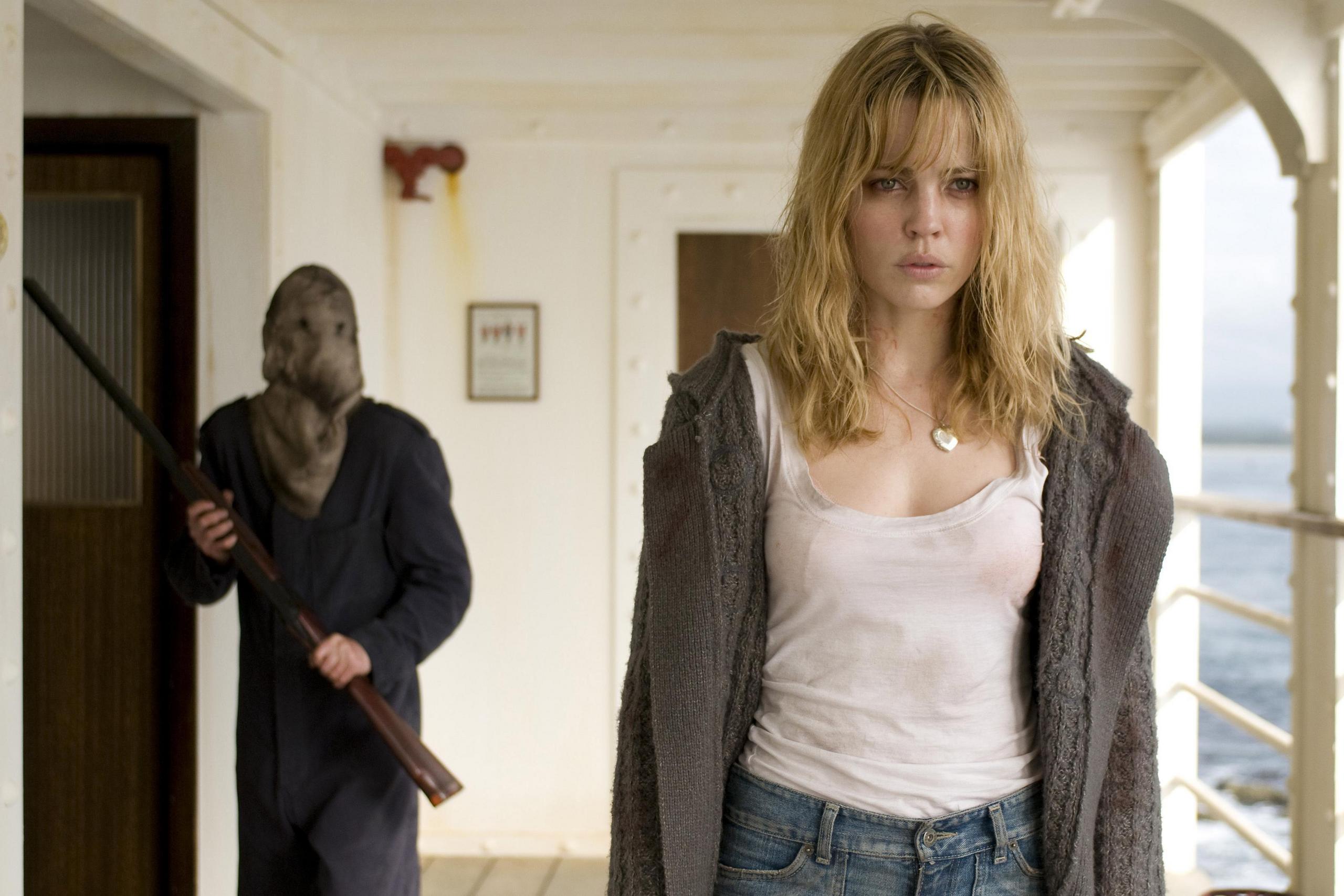
Hey there everyone! Welcome back to Movie Soapbox, the little corner of the internet that only you and I and that guy sleeping in the corner over there know about. This is the place where we find underappreciated indie films and we make sense of them. Today? We are doing a deep dive on Triangle, a movie so relentlessly, meticulously cruel in its construction that the first time you watch it you think it’s broken, and the second time you watch it you realize it never missed a single step, and the third time you watch it you start to feel a little sick about what it’s actually saying about the woman at the center of it.
Alright. If you have not seen Triangle, close this tab, go watch it, come back. I am not going to be gentle about what happens in this film, and the experience of watching it cold, not knowing what’s coming, is one of the genuinely irreplaceable things it has to offer. You get one shot at that. Don’t waste it reading a breakdown first. Everyone else, you know what you signed up for, let’s get into it.
Before we go scene by scene, there’s something worth naming about what kind of film this actually is, because it matters for understanding how it got made and why it feels the way it feels. Triangle is a British-Australian co-production from 2009, written and directed by Christopher Smith on a budget that, at this cast tier and this scope, almost certainly meant Smith had to defend every single structural choice to people whose instinct would have been to simplify it. You can tell when a film this mechanically precise came from a single controlling vision, because the logic is airtight in a way that committee-noted screenplays never are, committees sand down the sharp edges, they make the rules easier to follow, they add a scene where a character explains what’s happening because a test audience in Burbank said they were confused. This film never explains. It trusts you to catch up. That’s a creative decision that gets overruled in roughly eight out of ten development processes, which means Smith either had final cut protection baked into his deal or he fought for every frame of ambiguity in this thing. Either way, the fact that this movie exists in the form it exists in is not a given.
Now. Let’s sort out the Jesses, because if we don’t do this up front the rest of the walkthrough is going to be a disaster. There are multiple iterations of Jess moving through the same loop at the same time, and we need names for them. So here’s the taxonomy we’re using:
- Jess1 (Sweater Jess) — the iteration we board the yacht with at the start
- Jess2 (T-shirt Jess) — the loop-aware iteration who tries to intervene
- Jess3 (Bag Jess) — the iteration who has fully committed to the logic of the loop
- JessN (Dress Jess) — the version we see at the house, the one who reveals what this whole thing is actually built on
When offshoots matter, we’ll call them out. Fair enough. On with it.
The film opens on a line you are not supposed to remember yet. Jess is talking to her autistic son Tommy, and she says, “You just had a bad dream, baby. Bad dreams make you think you’re seeing something that you aren’t.” Tuck that away. Then she’s in a taxi, then she’s at the harbor, then she’s on Greg’s yacht with five other people: Greg, who owns the boat and invited her; Heather, who is Greg’s blind date and who the film disposes of so fast she barely registers; Victor, the hired hand who already doesn’t trust Jess because she couldn’t immediately account for where Tommy was; Downey, Greg’s childhood friend; and Sally, Downey’s wife, who dated Greg in eighth grade, which is the kind of detail that exists to make the social geometry of the boat feel lived-in and slightly uncomfortable.

The storm comes. The boat capsizes. Heather is gone. And then, out of the flat calm afterward, a massive ocean liner appears, the Aeolus, sitting there like it’s been waiting. The five survivors board it. And this is where the film starts running its mechanism.
Deep Dive Triangle Movie Walkthrough
Revolution One. The five walk the corridors. Victor finds Jess’s keys. They find the dining hall. Jess1 sees someone. Victor goes to investigate. Greg and Jess1 find a cabin numbered 237, the same as her home address, water running, and a message written in blood: “Go to the theater.” Victor comes back bloody, attacks Jess1, and she kills him by driving her finger into a wound in the back of his skull. She gets to the theater and finds Greg shot, Downey and Sally in chaos. Someone on the balcony shoots Sally and Downey. As they’re dying, they tell Jess1 that she was the one who shot Greg. Someone chases Jess1 into the engine room. They fight on deck. Jess1 gets an axe, gets the advantage over who she doesn’t yet know is Jess3, and Jess3 goes overboard saying, “Kill them all. It’s the only way. Kill them.” Jess1 stumbles into the phonograph. The needle lifts. The loop hitches. And she hears voices below calling up to the ship for help.
Revolution Two. She’s Jess2 now, or she’s entering the iteration where she starts to understand. She’s standing around a corner from herself. The “Go to the theater” sign was already written on the wall when she got there. She finds Downey’s body being picked apart by gulls. She tries to get Victor’s attention and accidentally kills him against a spike in the wall. “I didn’t do this. I didn’t do this.” In the hold, she finds notes written in her own handwriting, hundreds of them, stacked, all saying the same thing: “If they board, kill them all.” She crumples one up. Which adds one more to the pile. She finds her necklace, and then finds a pile of hundreds of identical necklaces on the floor. The film lets that image sit there without comment, because it doesn’t need comment. She understands now. She’s been here so many times she can’t count them. Jess2 decides to break the loop by going into the dining hall and stopping Victor’s death. She gets to the theater and shoots Jess3 in the head. She gives the gun to Downey and tells him to trust no one. And she watches herself, from the other side of the railing, fighting on the deck. Which is the end of loop one. Which means she didn’t break anything.
Revolution Three. Jess3 is the iteration that has stopped trying to save anyone. She’s committed to the logic that was handed to her on the overboard: kill them all, and the loop resets, and she gets home. She uses the blood to write “Go to the theater.” She dumps Downey and Sally into the ocean. She dresses like Bag Jess, gets the ammo, follows Greg to the theater balcony. She tells him, “I don’t want you to see my face. This isn’t me. We aren’t here. We’re out there on the yacht. And when I kill you, we will return.” She kills them. She follows Jess1 into the hold. She goes overboard telling her to kill them all. And she wakes up on the beach. She made it out. She’s home.
And then she goes to the house and finds JessN inside, screaming at Tommy, hitting him, saying “I’m tired of cleaning up after you. All I ask is for one day off.” Jess3 goes around back, gets a sledgehammer, and kills JessN. She comforts Tommy. She tells him bad dreams make you think you’re seeing something that you aren’t. She puts JessN in the trunk. They drive to dump the body. She hits a seagull. She pulls over to move it and finds a pile of hundreds of dead seagulls. Then Tommy screams. The truck is already there. The crash happens. Tommy is on the street. Jess3 is standing next to the wreckage, alive. A taxi takes her to the harbor. “You will come back, won’t you?” “Yes. I promise.”
And she boards the yacht.
Now let’s talk about what’s actually holding all of this together, because there are several competing reads and they are not all equally earned by the text.
The Mechanics of the Movie Triangle
The first question is whether the loop is mutable or fixed. Every other film in this subgenre, Timecrimes, Edge of Tomorrow, ARQ, builds toward the idea that repetition is practice, that the loop is a puzzle you can solve if you find the right sequence of actions. This film is not doing that. Jess2 changes things and it doesn’t matter. Jess3 changes things and it doesn’t matter. The boulder goes back down the hill. Which is not an accident; the boat is named the Aeolus, and Aeolus’s son in Greek mythology is Sisyphus, the man condemned to roll a stone up a mountain for eternity as punishment for cheating death and betraying the gods. The film is wearing its thesis on the hull. Jess is not in a puzzle. She’s in a punishment.
So now the theories. And I’ll give them to you fairly.
Theories to Explain the Movie Triangle
Theory One: It’s a dream. Jess is stressed, her life is hard, she’s caring for an autistic son alone, and the whole film is her subconscious working through that pressure in a closed loop. It’s defensible. The opening line about bad dreams is there. The motifs are there. I’m not going to pretend this reading is stupid, because it isn’t. It’s just the least interesting thing the film could be doing, and I don’t think a screenplay this precisely constructed is doing the least interesting thing.
Theory Two: She’s dead and working through it. A variation on what Stay and Jacob’s Ladder do, where the repetition is purgatorial, a protagonist processing their own death. The problem is that Jess never arrives at peace. She never lays anything down. The films this theory borrows from require a release, a moment of acceptance. Nothing like that happens here. The loop doesn’t end with reconciliation. It ends with her on the taxi back to the harbor.
Theory Three: Pure Sisyphean commentary. The film is just saying life is toil and then you die. A humanist pessimism play. Possible. But the specificity of what JessN is doing at 8:17 makes this feel too thin. If it were just a metaphor for the general awfulness of existence, you don’t need that level of precision in the punishment.
Theory Four: The Sisyphean punishment, earned. And here’s where I plant my flag. The clocks on the ship are all stopped at 8:17. That is not a random time. 8:17 is the moment we see at the end of the film when JessN, unraveling under the weight of her life, is screaming at Tommy and hitting him. At 8:17, she takes that boy and drives him into an oncoming truck. She kills her son. She kills herself. And the loop is what came after. JessN is not an alternate Jess or a corrupted Jess, she’s the real Jess, the one who existed before the film started, and the Jess1 we’ve been following is the fiction, the self-image, the version of herself she can live with. The gods, or whatever force is running the Aeolus, didn’t spare her. They gave her exactly what she asked for. She wanted a day off from Tommy. She’s been off from Tommy ever since. Indefinitely. On a ship full of people she kills or watches die, over and over, forever, for what she did at 8:17.
The room number is 237. Her home address is 237. The ship brought her home and put a mirror up to it and made her write “Go to the theater” in blood and watch herself do it, again and again, until she can’t count the necklaces anymore.
Movie Soapbox’s Take on the Movie Triangle
That’s the reading I believe. Jess is Sisyphus. The Aeolus is the mountain. And the boulder has her son’s name on it.
Christopher Smith made this film for somewhere in the range of what amounts to a very small budget for a genre picture with this much structural ambition, and he made it airtight. The kind of airtight that only happens when one person was in the room where every decision got made, and that person cared more about the mechanism working than about whether a general audience in a multiplex would follow it on first watch. Most films like this get a scene where someone sits down and explains the rules. This one never does. It just runs the loop and trusts you to feel the weight of it accumulating. That’s what almost never survives the development process. That’s what Smith somehow kept. Go watch it again, and this time listen for the seagulls at the very beginning.
Hey, thanks for hanging out here at Movie Soapbox. We’ll be back with another one soon, and we will keep finding the films that almost didn’t make it out the way their makers intended, and we will keep making sense of them, just the two of us and that guy in the corner who still hasn’t woken up. See you next time.