
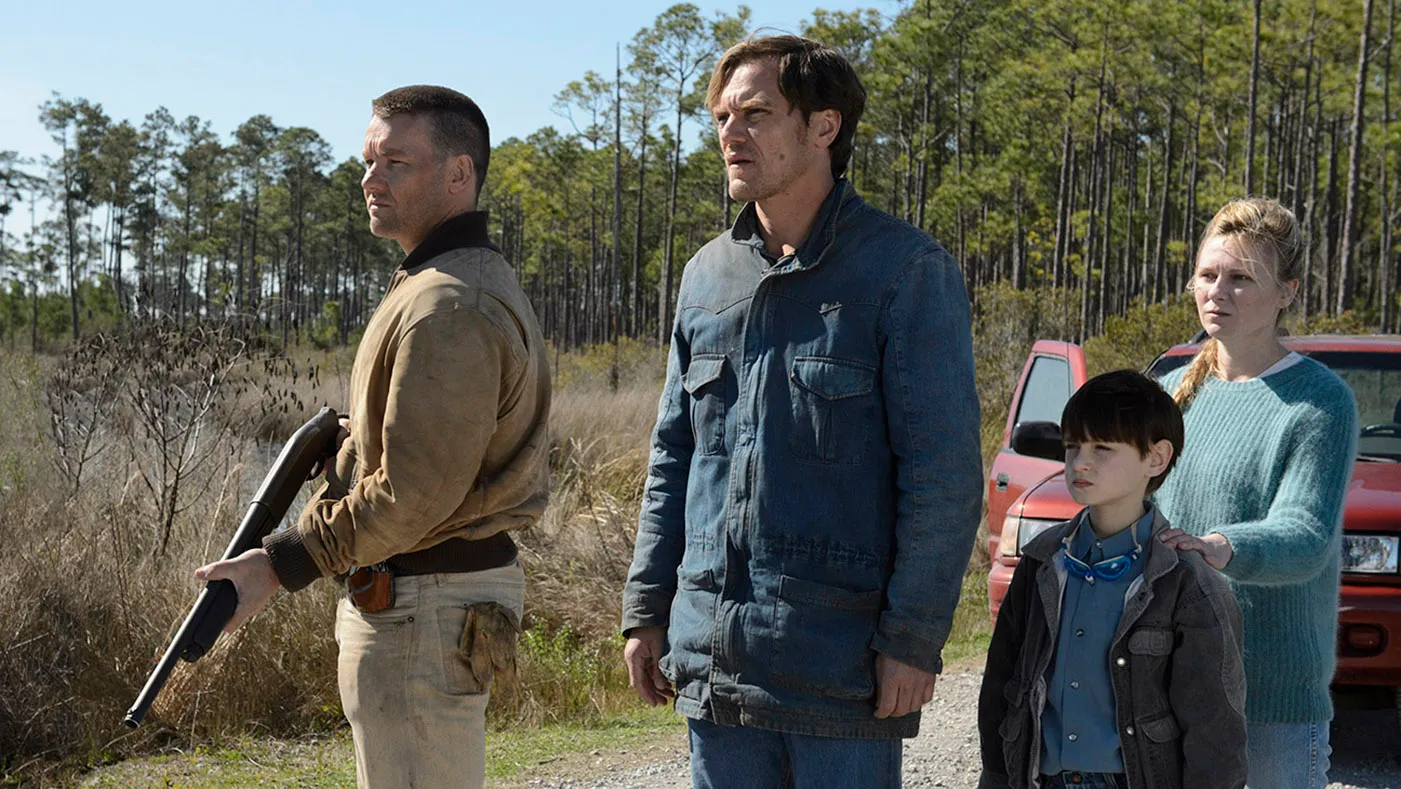
Hey there everyone! Welcome back to Movie Soapbox, the little corner of the internet that only you and I and that guy sleeping in the corner over there know about. This is the place where we find underappreciated indie films and we make sense of them. Today? We are doing a deep dive on Midnight Special, a movie so quietly devastating in what it asks of you that the studio system practically didn’t know what to do with it, and the box office numbers prove it.
Before we get into it, let’s get you oriented with the trailer.
Alright. If you haven’t seen Midnight Special yet, here’s what Moviesoapbox says to you directly: stop reading, go find it, and come back. Because Midnight Special is actually a better version of Stephen Spielberg’s Disclosure Day… it’s that good. And what follows is a full dissection of this film, every beat, every theory, every mechanism, and I will not be protecting you from any of it. You’ve been warned. Everyone else, let’s get into it.
The Making of Midnight Special
Jeff Nichols made a film that cost somewhere in the low-to-mid eight figures to produce, attached Michael Shannon, Kirsten Dunst, Joel Edgerton, and Adam Driver to it, got it into wide release through Warner Bros., and watched it gross three and a half million dollars in two weeks. Three and a half million. You need to sit with that number for a second, because that number tells you everything about the current relationship between the studio distribution apparatus and any film that refuses to announce its genre intentions in the first ten minutes. A film like this, a slow-burn, father-son fugitive story that is also a supernatural parable that is also a Christ allegory that is also a meditation on what it means to let a child go, that film lands in the Friday-to-Sunday tracking system and the algorithm genuinely does not know which quadrant to assign it. So the prints go out, the marketing shrugs, and the opening weekend looks like a documentary about competitive forklift operation. What you’re watching when you watch Midnight Special is a Jeff Nichols film that survived the greenlight process entirely because of its cast, and then got handed to a marketing department that had no idea what they were selling. That reshoot scar you sometimes feel in a third act that doesn’t quite fit? This film doesn’t have one. That’s the miracle. Nichols held the cut.
Midnight Special Deep Dive Walkthrough
So. The movie opens on an Amber Alert spreading across Texas and the surrounding states. A boy is missing, probably taken by his biological father from something called The Ranch. We catch up fast: the boy is Alton, the father is Roy, and riding with them is Lucas, one of Roy’s childhood friends who signed on for reasons the film lets you fill in yourself. They can only travel by night. Something is wrong with Alton, or something is happening to Alton, and daylight is part of the problem. Three men and a kid in a blacked-out car, burning south, with The Ranch, the NSA, the FBI, and every local news affiliate in the region all pointed in their direction.
The Ranch is where this whole thing started. It existed before Alton was born, Roy and his wife Sarah probably met there, married there, and had Alton there. The moment it became clear Alton wasn’t a normal child, a cult elder named Doak claimed him, folded him into the theological infrastructure of the community, and started building a religion around what Alton was doing. Which is what cults do, find a phenomenon they can’t explain and construct a cosmology that puts them at the center of it. Doak rescheduled the Ranch’s services to the middle of the night so Alton could attend. He began treating Alton’s transmissions as prophecy. He calculated, from whatever Alton was outputting, that a judgment day was four days away, and that without Alton present, the Ranch members wouldn’t survive it. Sarah eventually hit the wall on cult life and left. Roy stayed. That’s your Boyhood structure, the father and the son, and everything else is scaffolding around it.
What Alton is actually doing, and Paul Sevier from the NSA is the one who figures this out, is not prophecy. Alton is a biological receiver. He’s been intercepting and decrypting classified military satellite transmissions without knowing he’s doing it, and what the Ranch heard as divine utterance was Alton channeling encrypted government communications. Sevier identifies the pattern, traces it, and realizes that the random numbers scattered through Alton’s sessions, “35 47 97 52,” “53 23 77 127,” all of it, are coordinates and codes pulled from the satellite network Alton was unconsciously hooked into. One of those satellites, DSP9712, was tasked with tracking nuclear launches. Alton brought it out of the sky after he realized it was tracking him. Sevier is smart enough to follow the signal backward and figure out where Alton is trying to go.
The physical deterioration threading through the middle of the film is the mechanism Nichols uses to raise the stakes without a single action beat that feels engineered. Alton is leaking. Light from the eyes, the coughing, the dissociated radio-voice Spanish coming out of him at random, he’s coming apart, and Roy is watching his son dissolve in real time while trying to keep federal agencies and a cult’s retrieval team off their trail simultaneously. Shannon plays all of this with a stillness that most actors at his level would have overplayed into tragedy-face, and he doesn’t, because the grief is already in his posture, it’s in how carefully he handles Alton, and you don’t need a speech about it.
The sunrise sequence in the field is the film’s pivot. Roy objects, Alton insists, something enormous and inarticulate happens in the light, and when they arrive at the hotel afterward Alton looks, as the film puts it, right as rain. Bags gone. Eyes clear. He can look directly at the sun. Whatever needed to complete itself in him, completed. This is the rebirth beat, and Nichols does not stop to explain it to you, which is the correct decision and also the decision that probably cost the film another million dollars in opening weekend gross.
Lucas gets shot on the hotel balcony by the Ranch retrieval team. They zip-tie the adults, pillowcase over Alton’s head, and they’re gone. By the time Roy, Sarah, and Lucas catch up to the trail, the Ranch guys are dead in their car and a government helicopter is already in the air. The NSA has the boy. What follows is the film’s version of the government-as-antagonist act, but Nichols won’t let it be a thriller, because Alton is running the interrogation. He asks for Sevier specifically. He loops the monitoring feed. He unlocks the door from the inside. He carjacks a Prius and overloads the base’s electrical grid on the way out. A kid who can barely stand up straight has just dissolved a federal containment operation through pure will and technical fluency, and the film treats it as quietly as everything else.
Paul Sevier makes the decision to hand Alton back to his family and ask to come along. Roy says no. Sevier asks for Lucas’s handcuffs, not as a prisoner but as cover, plausible deniability if this goes wrong, and that small practical human request is the most character work Adam Driver gets in this film, and he makes it count. The four of them push toward the geolocation Alton has been broadcasting toward the entire film, with the full weight of federal resources now converging on the same coordinates, because Sevier passed the location on before he switched sides.
The final sequence. They ram the checkpoint. Sarah and Alton break off into a field. Roy and Lucas keep driving to draw the pursuit. And then Alton opens something. A four-state radius of sky splits open and shows you the other world sitting right on top of ours, silver towers, other beings, the architecture of something that has been watching us from the other side of a membrane we didn’t know existed. Alton is met by these others and taken through. The window closes. Roy and Lucas go to jail. Sevier sits across from Roy in an interrogation room and asks his questions, and the implication is that Sevier is the only person in the federal system who actually understands what he’s asking about. Sarah is gone, hair dyed, driving into a horizon that the film doesn’t follow her into.
Now. The theories. There are a few floating around, and I’ll give them each a fair account before I tell you which one I believe.
Theories to Explain Midnight Special Movie
Midnight Special Theory #1 – The first one barely qualifies as a theory and I’ll dispatch it quickly: the Collective Hallucination read, the idea that Alton is experiencing some kind of psychogenic break that infects everyone around him and the supernatural elements are mass delusion. It doesn’t survive contact with the film’s internal logic. The satellite data is real. The federal response is real. The encrypted transmissions are real. You’d need to retroactively hallucinate the entire geopolitical intelligence apparatus, and that’s not a theory, that’s giving up.
Midnight Special Theory #2 – The second is what I’ll call the Secret Service theory. The beings on the other side of that membrane have been watching humanity for long enough that passive observation has given them everything it can give. So they send a child born of both worlds, part human, part other, to experience human life from the inside. Alton is an embedded observer, a mixed-race envoy in the most literal sense, gathering data that pure surveillance could never produce. Under this read, the Ranch’s messianic interpretation and the NSA’s weapons-program interpretation are both wrong, and the truth is something more procedural and strange: Alton is a long-term research investment who has reached the end of his field assignment and is being recalled.
Midnight Special Theory #3 – The third theory is the one I believe, and I want to be precise about why. The Ascension theory reads Alton as a Christ figure, not metaphorically, structurally. Born of two natures simultaneously. His presence destabilizes every institution that tries to contain him, the religious one and the governmental one, because neither framework was built to account for what he actually is. He undergoes something that functions as death in the field with his father, and comes through it changed, clarified. He spends the remainder of the film moving with a calm that the people around him can’t match because he already knows how this ends. And the final sequence, Sarah watching as her son is received into another dimension by beings of light, is the Ascension. Nichols isn’t being subtle about it. Go read Acts 1:9-11 and then watch that field sequence again. The visual grammar is identical: the witnesses standing on the ground, the figure rising, the others waiting. The film doesn’t announce the parallel because Nichols trusts that the image will do the work, and it does.
What makes this more than a clever structural overlay is that it reframes Roy’s journey in a way no other reading can. Roy is not a father who loses his son. He’s a man who was chosen, for reasons the film never explains, to carry something through the world that was never his to keep, and who does it anyway, at the cost of everything, because the love is real even if the child was never fully his. That’s not a sci-fi premise. That’s the oldest story there is, and Jeff Nichols had the nerve to dress it in a chase movie and release it into the multiplex ecosystem and watch it gross three and a half million dollars.
Sevier gets to keep asking questions. Roy goes to jail. Sarah runs. Alton goes home. Nobody gets a resolution that resolves anything cleanly, because Nichols told you at the start he wasn’t interested in plot concision, and the ambiguity isn’t a failure of nerve, it’s the whole point. You want the loose ends tied because you’re human, and the film is asking you why. That’s the question underneath the movie. Why does it bother you so much not to know?
A film this precise, this patient, this unwilling to flinch in its final act, gets greenlit because Michael Shannon says yes and Warner Bros. sees a cast they can put on a poster. And then it earns three and a half million dollars and disappears. That’s the machine. The film survived it intact. Most films like it don’t get that far.