
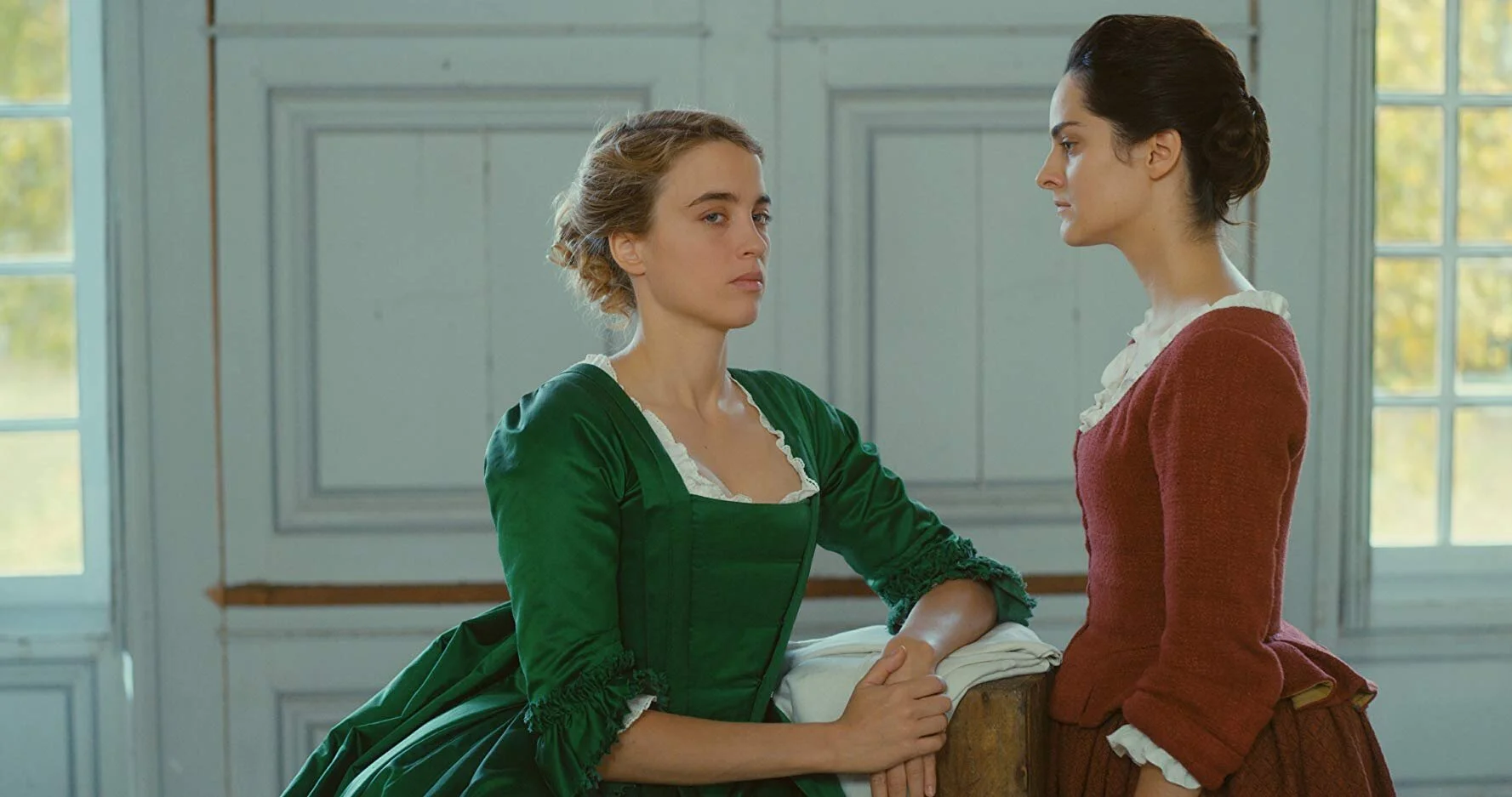
Hey there everyone! Welcome back to Movie Soapbox, the little corner of the internet that only you and I and that guy in the back who hasn’t blinked in forty minutes know about. This is the place where we find the films that got made in spite of everything, and we make sense of them together. Today we are doing a full deep dive on Portrait of a Lady on Fire, a film so quietly devastating, so committed to a single idea about what it means to truly look at another person, that the marketing departments of three different countries apparently had no idea what to do with it.
Before we go any further, understand that everything from this point on is a spoiler. The ending, the myth, the final image of Héloïse sitting in a concert hall, all of it. If you haven’t seen this film yet, close this tab, watch it, come back. It’ll still be here. It’s that kind of movie. You owe it the full experience before someone else’s words get in the way.
The Making of Portrait of a Lady on Fire
So, Portrait of a Lady on Fire. Céline Sciamma wrote it, directed it, and apparently had a very clear idea of exactly what she wanted from frame one, which is the kind of creative certainty that makes studio development executives deeply uncomfortable because there is no obvious gap to insert a note into. A film this precisely controlled, this deliberately paced, with this little happening on a plot-mechanics level, reads on a coverage report as a problem to be solved. The fact that it arrived onscreen looking exactly like the vision of one person, not a vision sanded down across eighteen months of weekend-notes calls, tells you something about the production circumstances. Films this coherent at the level of intention don’t happen because the system helped. They happen because the system either wasn’t paying close enough attention or couldn’t figure out where to stick its hand in. At a budget level where the suits are mostly absent and the distributor isn’t getting involved until after the cut is locked, the director sometimes actually gets to make the film. That appears to be what happened here. And you can feel it in every uninterrupted silence.
The Portrait of a Lady on Fire Detailed Walkthrough
The movie opens, and you’re already in the middle of it. Marianne, played by Noémie Merlant, is teaching a painting class when one of her students notices a canvas she keeps turned away from the room. She tells them its title, Portrait de la jeune fille en feu, and the whole film snaps into focus as a memory. Everything we are about to see is something Marianne is carrying, has been carrying, will carry until the actual end of her life. That framing device is not a trick or a gimmick. It is the argument. The film’s entire claim about love and loss is embedded in the structure before the first real scene begins.
Pull back into the memory. Marianne has been summoned to an island in Brittany to paint a portrait of a young woman named Héloïse, played by Adèle Haenel. The portrait is a condition of Héloïse’s arranged marriage. Héloïse knows this, refuses to sit for it, and so Marianne is instructed to observe her secretly during walks and conversations, memorizing her face, and paint from memory in private. The surveillance is the job. The friendship, the proximity, the intimacy of two people genuinely looking at each other, that starts as cover and becomes the actual story.
When Marianne finishes the first portrait under those conditions, she realizes almost immediately what she has done. She has rendered a woman she has started to care about as an object, a commodity to be shipped off with a painting as proof of value. Héloïse sees it, calls it dead, notes that whoever painted it captured her face and missed her entirely. Marianne destroys it. Héloïse’s mother, before leaving for Italy for a few days, gives Marianne another attempt. And in that window, in that temporary suspension of the outside world’s rules, the two women’s relationship completes its transformation.
The hinge the film swings on is the myth of Orpheus and Eurydice, which Marianne and Héloïse read together and then argue about, and which Marianne later paints, and which the film essentially IS, told from Eurydice’s point of view for once. Here is the myth, stripped down: Orpheus descends into the Underworld to retrieve his dead wife Eurydice. Hades allows it on one condition, Orpheus must walk out without looking back at her. He fails. He turns. She is pulled back into the dark. The standard reading is that Orpheus couldn’t resist, that desire overrode discipline, that he lost her because he loved her too much to trust the deal. But Héloïse offers a different read in the film. She says maybe Orpheus turned back on purpose. Maybe that last look was a gift. Maybe he gave Eurydice the memory of being seen before the dark took her back. The film lives in that reinterpretation. The gaze that costs you everything might still be worth taking.
The two women spend only around two weeks together before the world reasserts itself. Héloïse’s marriage will happen. Marianne will leave. The film doesn’t pretend otherwise and it doesn’t soften the landing. What it does instead is give you two scenes after the separation that land like a hand closing around your chest and not letting go. The first is at a gallery where Marianne has exhibited her Orpheus and Eurydice painting under her father’s name, because women didn’t show work publicly in this era, and the painting depicts the exact moment of the look, Eurydice’s hand reaching back toward the light as she descends. Marianne finds a portrait of Héloïse, now married, holding her child, with a book open in her lap to page 28, the page where Marianne once sketched herself. Héloïse kept it. She has been holding page 28 this whole time. The second scene is the last image of the film: Marianne watches Héloïse at a concert, alone in the audience, hearing Vivaldi’s Summer Presto for the first time in a proper hall, and the camera holds on Héloïse’s face as the music moves through her. Marianne is not beside her. She is watching from a distance, as she always was, memorizing.
Portrait of a Lady on Fire Untangled
There are a few things worth untangling for clarity. The film moves between two time periods and the structure can blur at first: the contemporary framing (Marianne as an older woman, teaching, the painting in the corner) wraps the central memory (the two weeks on the island). Everything on the island is memory. The book at page 28 in the gallery scene confirms that Héloïse carried the sketch forward into her married life, this is not ambiguous, it is a deliberate image placed precisely by a director who doesn’t waste frames. The sister backstory, Héloïse returned from a convent after her sister’s apparent suicide, functions as context for Héloïse’s determination to control what little she can about her own fate. The class inversion during the mother’s absence, maid posing, Héloïse cooking, Marianne painting, everyone rotated out of their assigned slot, is Sciamma showing you what life could look like if the architecture of class and gender were briefly suspended. It’s a window, not a solution.
Portrait of a Lady on Fire Competing Theories
The Straightforward Read of Portrait of a Lady on Fire – The competing interpretations of this film mostly center on the Orpheus question, specifically on who Orpheus is and who Eurydice is. The straightforward read assigns Orpheus to Marianne, the one who must eventually look back and lose, and Eurydice to Héloïse, the one who is claimed by the underworld of a society that will not let her exist freely.
The More Provocative Read of Portrait of a Lady on Fire – The theory that the film seems to quietly prefer, is that Héloïse’s question reframes the myth entirely: Orpheus chooses the look. The poem Marianne paints, the Orpheus-and-Eurydice canvas, shows Eurydice reaching. She is not passive. She is the one extending toward the light.
The Theory from Eurydice’s Perspective of Portrait of a Lady on Fire – The third read pushes further: the film is told from Eurydice’s perspective, Sciamma has said as much, and that means the tragedy belongs to the one who is taken back, not the one who fails to hold on. The memory is Eurydice’s, not Orpheus’s. The final concert scene, Héloïse in rapture with music she only knows because of Marianne, alone, surrounded by the life that closed around her, is the film’s definitive statement on this: the gaze was real, it cost everything, and it cannot be taken back.
Moviesoapbox’s Personal Preferred Read is the third one – I’m not hedging here. Sciamma told you in the structure: this is Marianne’s memory, yes, but the film’s emotional center of gravity lives in Héloïse, and the film ends on Héloïse’s face because that is who paid the highest price. Marianne kept her art, her life, her freedom to move. Héloïse kept page 28 and a piece of music she heard once. The final shot holds on her face because Sciamma is asking you to look at the person the world refused to look at clearly, and the film is the act of that looking. That’s what the female gaze manifesto actually means when it’s working at this level. A gaze that outlasts the rules that tried to prevent it.
A film this precise, this unhurried, this completely uninterested in giving you a plot mechanism to hold onto, should not exist in a landscape where even prestige distributors are asking what the hook is and whether there is a sequel. It exists because someone made it at a scale where the usual interventions couldn’t reach it, and because the vision was clear enough and complete enough that there was nowhere for a committee to insert itself. That is the rarest possible condition for a film to be made under. Most films at this level of ambition arrive onscreen with a reshoot scar where the conviction used to be. This one doesn’t. You can feel the absence of that scar in every held shot, every silence that doesn’t flinch, every moment that trusts you to stay with it without being pushed. Go watch it again – and give it another chance through this lens.
If You Liked Portrait of a Lady on Fire…
Lady Macbeth (2016) – Period piece about a woman suffocating under convention who refuses to stay put. Same quiet fury, completely different direction.
Certified Copy (2010) – Kiarostami’s masterpiece about art, authenticity, and a relationship that may or may not be real. If you loved the gaze in Portrait, this will wreck you.
Clouds of Sils Maria (2014) – Two women circling each other through art and performance. The power dynamics shift the same way they do in Portrait — slowly, then all at once.