
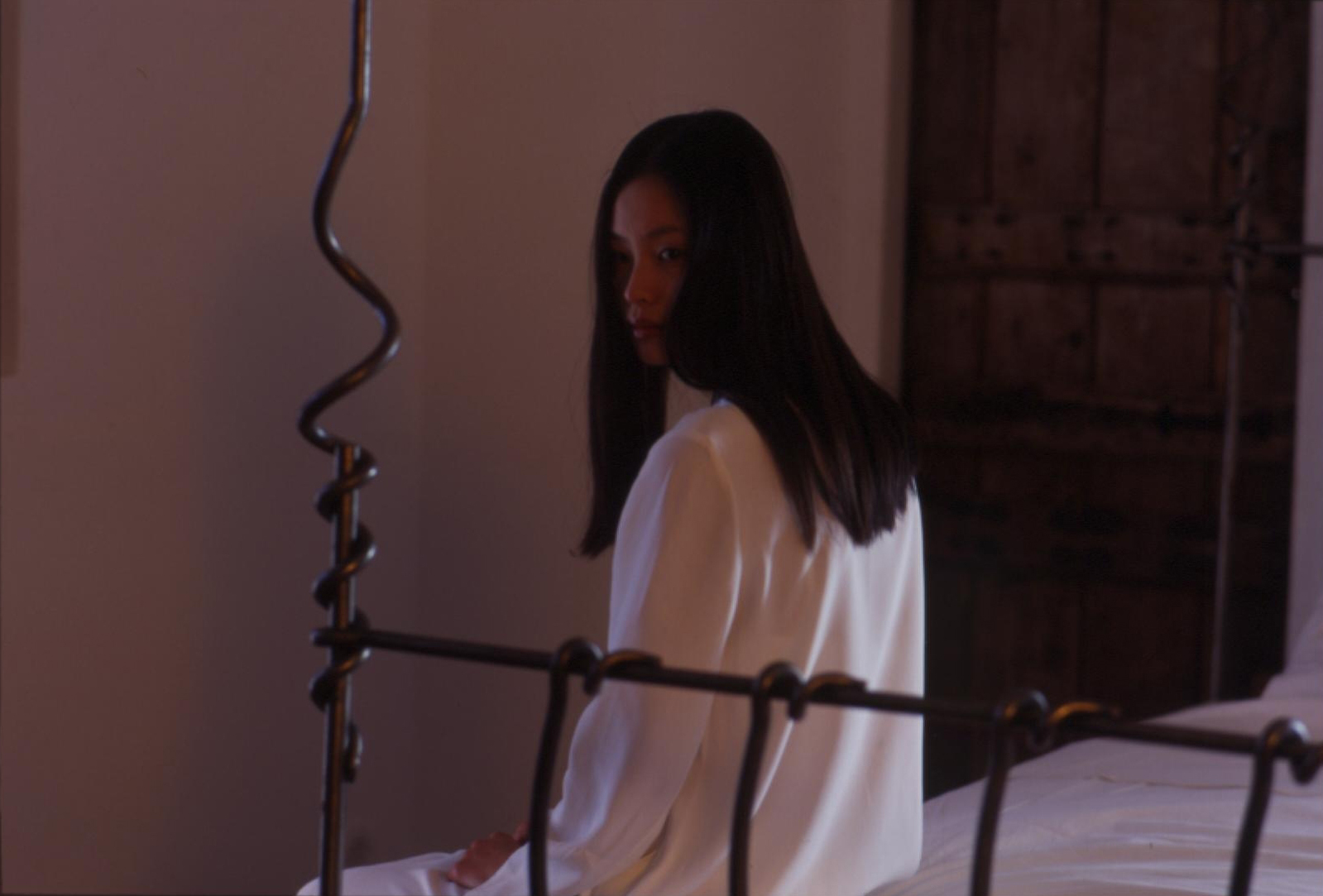
Hey there everyone! Welcome back to Movie Soapbox, the little corner of the internet that only you and I and that guy sleeping in the corner over there know about. This is the place where we find underappreciated films, foreign, indie, the ones that slipped through the cracks or got shoved through them, and we make sense of them. Today? We are doing a deep dive on Audition, Takashi Miike’s 1999 J-horror slow-burn, a movie so deceptively gentle in its first half and so completely unhinged in its second that the people who distributed it outside Japan genuinely did not know what they were selling, which, honestly, is the only reason it still exists in the form you can actually watch it in.
Before we go any further, I need you to understand something: everything from this point forward is a spoiler. The whole movie. The bag on the floor of the apartment, what’s in it, the needles, the feet, all of it. If you have not seen Audition and you want to go in clean, close this tab, watch it, come back. I am not going to hold your hand through this. Miike didn’t hold anyone’s hand and neither will I.
Here is what you have to understand about Audition‘s position in the market in 1999. Miike was operating at a budget tier where the people holding the money expected a certain kind of product. A J-horror with a female antagonist, post-Ring, post-Cure, should have been a ghost picture. Pale woman, long hair, a haunted object, a curse with rules. That was the playbook distributors understood and could sell to international buyers. What Miike handed them instead was forty-five minutes of a widower falling sweetly, almost unbearably gently, in love, followed by twenty minutes of imagery that has no genre equivalent anywhere in world cinema at that point. You can feel, if you know what to look for, the places in this film where a less stubborn director would have pivoted toward something safer. The audition sequence itself, the whole romantic-comedy scaffolding Miike erects with a straight face in the first act, reads like a man deliberately spending every ounce of goodwill the genre gave him before he burns the building down. He got this through because nobody reading the early pages suspected what the last reel was going to do to them. That is not a lucky accident. That is craft deployed as misdirection, at the production level, before the camera ever rolled.
Audition Movie Deep Dive Walkthrough
Shigeharu Aoyama’s wife dies in the opening minutes, and Miike doesn’t linger. A hospital room, a year marker, and then we’re years forward and Aoyama’s teenage son Shigehiko is telling his father, with the blunt sincerity of a kid who loves his parent, that it’s time to find someone new. Aoyama isn’t resistant so much as he’s hollowed out, the kind of grief that doesn’t perform itself anymore, it just sits there behind his eyes while he goes through the motions of a normal life. His friend Yoshikawa, a film producer, hatches the scheme: they’ll hold a fake audition for a film role, and Aoyama will use it to scout a new wife. You already know this is going somewhere terrible. What Miike makes you do is enjoy the journey anyway.
Aoyama reads through the audition tapes and submissions, and then he gets to Asami Yamazaki, and the film shifts register entirely. She’s not like the others. She’s still, and precise, and carries something in her face that reads as depth but you will later understand is damage. Aoyama is immediately, completely gone on her. And Yoshikawa, doing what any responsible person would do, tries to run down her references and finds nothing. Nobody knows her. Her resume is vapor. Her ballet instructor, her former employer, all of it leads nowhere or leads somewhere actively alarming. Yoshikawa tells Aoyama to walk away. Aoyama does not walk away.
Asami’s apartment, when Aoyama sends someone to check it, is almost empty. A phone. A large burlap sack on the floor. We don’t find out what’s in the sack yet, Miike makes you sit with it, makes you file it away as a detail, makes you move on. He is very patient about this. The sack will come back.
Aoyama and Asami have dinner, then more dinners, and eventually they spend a night together at a hotel. She is attentive and fragile and damaged in ways she hints at but doesn’t explain, and Aoyama, who has been grief-paralyzed for years, feels something crack open in him. He tells her he loves her. He tells her she’s the only one. In the morning, she’s gone. Not checked out properly, not a note, just gone. And when he tries to find her, every lead dissolves. The ballet instructor she named turns out to be dead. The bar she worked at is a crime scene. A music producer connected to her past is missing three fingers, an ear, and his tongue, and is currently living in a bag on her apartment floor, surviving on what she feeds him, which we see in a sequence I will not describe in detail except to say Miike shoots it with the same calm, unhurried visual grammar he uses for the romantic scenes. Same lens. Same light. That tonal consistency is intentional and it is the thing that makes it so hard to shake.
Aoyama comes home. He pours a drink from the decanter in his study. And here is where the film’s structural argument begins in earnest, because what happens next exists in at least two simultaneous states and Miike refuses to collapse them into one.
The drink is drugged with a paralytic. Asami is there. Aoyama can’t move, can’t speak, can only watch and feel. She explains herself, quietly, almost tenderly: he promised her she would be the only one. He lied. Everyone lies. She has a method for making the lying stop. What follows is the film’s notorious climax, needles inserted with surgical precision under his eyes, then a hacksaw, and his left foot, then his right. And then Aoyama’s son Shigehiko comes home. And then Asami turns to deal with him. And then.
And then Aoyama wakes up. In bed. Next to Asami. And she smiles at him and tells him how lucky she is.
Miike does not explain this. He gives you the tools to explain it yourself, and then he gives you one more sequence, after the film’s apparent ending, that destabilizes whatever explanation you’d settled on. The literal order of events as the film presents them in its final stretch goes like this: flashback to Aoyama telling Asami the truth about the fake audition, then the torture sequence, then Aoyama waking in bed with Asami who acts like nothing happened, then Asami attacking Shigehiko in the real house with Aoyama injured on the floor, then Shigehiko throwing her down the stairs, her neck breaking, her dying, Shigehiko calling the police. And then, after all of that, one final image: Asami in her studio, alone, putting on her ballet shoes.
Audition Movie Explanation Theories
Audition Movie Theory #1 – The Literal Read
The dream sequence in the middle of the film was a genuine nightmare Aoyama had, a premonition or a guilt-dream, and the torture and the aftermath are real events. Asami is a genuinely dangerous, severely traumatized woman who goes to Aoyama’s home and does what she does. The final image of her in the ballet studio is a memory, or a ghost, or just Miike refusing you a clean exit.
Audition Movie Theory #2 – Nothing Happened
Aoyama’s grief is so profound, his guilt about wanting to replace his wife so consuming, that the entire second half of the film is an elaborate psychological projection. Asami may not exist in any meaningful sense. The siren quality she has in the early scenes, the way she’s lit almost supernaturally, the fact that no one can verify she exists, all of it points to a man conjuring a punishment for himself, building a woman out of his own guilt and desire and then having her destroy him for it.
Audition Movie Theory #3 – Asami is Real
The third reading is the one that sits underneath both of those: Asami is real, and she is an embodiment of what the audition scheme deserved to produce. Aoyama used the machinery of professional evaluation to shop for a wife, reduced women to auditionees, and conjured into his life someone who would hold him to his promises with absolute literalism. She is, in this reading, less a character than a verdict. She is what you get when you treat love as a casting call.
Moviesoapbox Audition Movie Explanation
My read? The second and third aren’t mutually exclusive, and I think Miike knew that and built the film to hold both at once. But the frame I keep coming back to is this: Asami is a siren in the original sense, the mythological creature who exists specifically to punish the man who reaches for the wrong thing. You cannot verify her because she is not a verifiable thing. She exists in the same ontological space as Aoyama’s guilt. The burn scars on her past, the man in the bag, the complete absence of any traceable life, these are not the details of a real woman’s biography. They are the details of a haunting. Aoyama didn’t meet a dangerous woman at a fake audition. He summoned one.
And that’s the film’s actual argument, the one underneath all the violence. Grief has a shape, and if you ignore that shape long enough, if you try to skip past it with a clever scheme and a pretty face, it will show you that shape in the worst possible way. The relationship between Aoyama and his son Shigehiko is the film’s emotional core, and it’s the part that survives every reading: a father and a son who love each other and are trying to figure out how to keep living. Everything Asami does radiates out from what happens when you let that real, quiet, imperfect love get contaminated by an impossible ideal. The real tragedy is not the feet. The real tragedy is that the fishing trips had to end.
Audition came out in 1999, got passed around the festival circuit on VHS dubs before any distributor would touch it, built its reputation through word of mouth among people who couldn’t fully describe what they’d seen to people who hadn’t seen it. The kind of film that exists because one director was patient enough to disguise what he was making until it was too late for anyone to stop him. There are fifty films like this that didn’t survive the same process. Remember that the next time someone tells you the market knows best.