
Hey there everyone! Welcome back to Movie Soapbox, the little corner of the internet that only you and I and that guy in the back who keeps rewinding the last thirty seconds know about. This is the place where we dig into the films that factory Hollywood either ignored, mangled, or accidentally let through the gate while the committee was arguing about the font on a different poster. Today we are doing a deep dive on The Dead Center, a movie so quietly bleak and so committed to not explaining itself to you that it almost passes for a studio film that ran out of budget before the reshoots. Almost.
Before we go any further, understand that we are going into the full film, the ending, the mechanism of the evil, all of it. If you haven’t watched The Dead Center yet, close this tab, go find it on whatever streamer is currently hosting it, and come back when you’ve seen the lines of darkness crawl up Shane Carruth’s face. You want to experience that cold last shot before you read what it means. Trust the film that much, at least.
The Dead Center Movie Making Of
Now. What you need to understand right away, before we walk through a single frame, is what kind of film this could have been if Billy Senese hadn’t managed to hold the line. A horror film about a psychiatric ward, a body that keeps coming back, a contagion of evil that jumps hosts, anchored by a lead who has genuine film-nerd cultural weight attached to his name, that is exactly the kind of logline that gets a filmmaker invited into a room where twelve people who have never finished a novel all start having opinions about the third act. The fact that The Dead Center ends on ambiguity, on a single face going dark with no resolution and no sequel hook dressed up as closure, tells you something. Films at this budget tier with this kind of cast adjacency usually get that ending sanded down to a hopeful fadeout or a setup shot for a franchise that will never happen. Senese didn’t let that happen. You can tell because the film trusts its own silence in a way that a note-surviving third act never does.
The Dead Center Movie Deep Dive Walkthrough
So here is what the film actually does. It opens on two parallel tracks. Daniel Forrester, played by Carruth, is a psychiatrist at a mental health hospital, a man the film codes immediately as someone who takes on the cases nobody else wants because he believes something real is happening inside even the most unreachable patients. And then there is John Doe, a man who turned up somehow not dead after apparently dying, admitted to the ward as an unknown, catatonic, wrong in a way that doesn’t fit any diagnostic category Forrester has.
The third track is the detective, working backward from a hotel room full of blood and spiral patterns drawn into the walls, trying to figure out who this man was before he became a ward of the state. The spirals matter. Write that down.
When John Doe finally comes out of his catatonic state enough to speak to Forrester, what he says is not the language of psychosis. It is the language of something that has been inside a person and is using that person to describe itself. He says he died and came back, that it wasn’t the first time. That he couldn’t kill it. That it came back with him from the fire. That it moves around inside of him at night. That when he killed himself he thinks he made it stronger. Forrester, because he is the kind of doctor who actually listens, does not immediately reach for a diagnostic label. He keeps pulling the thread.
Meanwhile the detective is pulling his own thread and the two lines are going to meet somewhere terrible. He traces John Doe backward through a house fire where Doe should have died but didn’t, where Doe’s wife did. He finds the parents’ house. He finds the basement.
The basement is the film’s single most efficient piece of storytelling. A wall of research. Outbreaks of mass death across recorded history, unexplained, misattributed to plague and flu and biological contagion. The implication assembled not by a character monologuing at you but by a detective staring at a corkboard built by a man who was trying to understand what had entered him. This is the mechanism the film is proposing: something crosses back from death into a living body, and then it spreads, and history has been calling it disease ever since.
Doe had left a suicide note before opening his veins in that hotel bathtub. The note read: I am the mouth of death. None are beyond my reach. It comes from a fictional text the film calls the Covenant of Death. The wall in the basement is a man’s attempt to map every time this has happened before. Bubonic Plague. Flu epidemics. Mass death events that got filed under biology because nobody had a better category. The Dead Center is proposing they were all this. A host. A spread. A jump.
Forrester, trying to get Doe to talk again, administers Thiopental, a barbiturate that drops your central nervous system activity fast. It works. Doe surfaces long enough to tell Forrester the thing that should clarify everything but instead makes it worse: he needs to die. Forrester needs to cut his throat. Right now. Doe begins stabbing himself with the needle trying to do the job himself. And here is where you have to pay attention to the logic the film has built, because Doe is not asking to be killed because he wants to die. He is asking to be killed because he believes that is the only way to stop what is inside him from continuing. He already tried this. He already knows it doesn’t work. The film lets that contradiction sit there without resolving it, because Doe is not a reliable narrator of his own situation, he is a man who has been partially consumed by something he can only describe from the inside.
The Thiopental wears off. The darkness comes back. Doe goes for Forrester the same way he has gone for others, the same way the film codes every kill: a kind of draining, a proximity, lines of something wrong moving from one person into another. Forrester survives. Barely.
Later, after Forrester’s boss overrides him and orders Doe released into his father’s custody, Doe’s real identity comes through. His name is Michael Clark. He has children. He remembers them, briefly, and the film gives you just enough of that to understand what it cost to be Michael Clark before the thing got inside him. Then his father takes him home.
By the time Forrester and the detective reach Michael Clark’s neighborhood, Clark has already moved through his family and the detective and is working his way through the block, house to house, as fast as physically possible. The film doesn’t dramatize this as spectacle. It shows you the aftermath and then it shows you Clark still moving. The momentum is the horror. There is no dramatic confrontation score, no slowing down for the camera to appreciate the carnage. Clark is just working.
Forrester goes in with a syringe of Thiopental and a tire iron. They beat each other to pieces. Clark gets hold of Forrester’s face and starts the drain, the same pull he used on everyone else, and Forrester snaps out of it and beats Clark into the floor. Clark is a bloody ruin. Forrester is treated in an ambulance, catatonic, barely present.
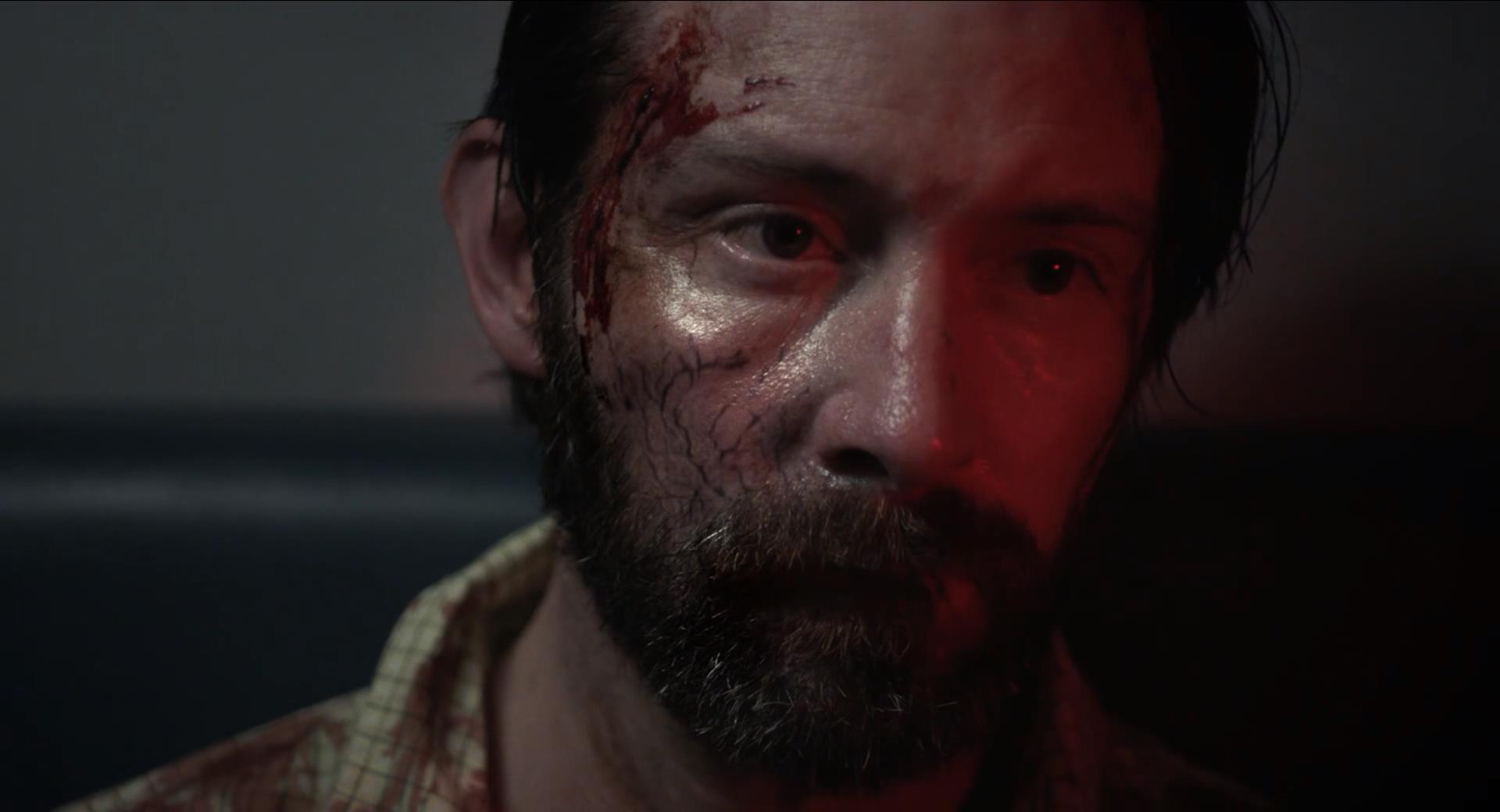
And then the camera holds on Forrester’s face. And the lines come up through his cheeks and his eyes. Dark threads spreading under the skin. Cut to black.
Theories to Explain the Movie The Dead Center
Three ways you can read that ending, and you should know all of them before you decide.
The Dead Center Explanation Theory #1 –
The first read is that Forrester won. Clark is destroyed, Forrester is alive, the darkness visible in his face is either a trick of the light or a temporary contamination that will pass. This is the read for people who need the protagonist to have functionally succeeded even in a horror film. It is not supported by anything the film has built, but it is available if you need it.
The Dead Center Explanation Theory #2 –
The second read is that Clark is not finished. The film has shown you Michael Clark die and return twice already. The bloody ruin in the house is not necessarily the end of Michael Clark any more than the hotel bathtub was. This read leaves the darkness in Forrester’s face as a separate problem and Clark as an ongoing one. Two threats, no resolution.
The Dead Center Explanation Theory #3 –
The third read is the one the film earns, the one every piece of mechanism in the film points toward, and it is the least comfortable. The darkness jumped. Whatever was inside Michael Clark, whatever crossed back from death with him in that fire and spread from him to every person he killed, found a new host when Clark grabbed Forrester’s face and Forrester held on long enough for the transfer to begin. The lines crawling up Forrester’s face are the same lines. Daniel Forrester is the new mouth of death. He is conscious, he is ambulatory, he is being discharged from an ambulance into a populated world, and nobody in that world knows what he is yet. The cycle restarts. The wall in the basement gets one more outbreak to document, whenever the next researcher finds it.
Moviesoapbox’s Read on the Movie The Dead Center
That third read is the correct one because it is the only one that makes the basement wall mean something. The point of that wall was never just backstory. The point was pattern. This has happened before, it will happen again, and the mechanism is not supernatural plague, it is a person who doesn’t know yet what they’ve become, moving through the world before anyone can stop them. Forrester is now at the beginning of Michael Clark’s story, not the end of his own.
What Billy Senese made here, with Shane Carruth in front of the camera instead of behind it, is a film about how evil survives through the people who try hardest to stop it. Not through the indifferent and not through the corrupt. Through the ones who lean in close enough to look it in the eye. That is a genuinely bleak and genuinely earned idea, and it almost didn’t make it to the screen with its ending intact. It’s the kind of film that exists because someone refused a note. You should watch it twice.
Thanks for spending some time here at Movie Soapbox. We’ll keep the lights on for you. In the mean time, if you are looking for other movies in this same vein, we got you covered:
🎬 If You Liked This…
- They Look Like People — the same intimate dread of trying to help someone you care about while suspecting they may be dangerous, the horror living in the gap between what you know and what you’re afraid to find out
- Daniel Isn’t Real — something wearing a person’s face that came back wrong, the same creeping horror of an entity that uses the shape of someone familiar to get close enough to do damage
- Take Shelter — the mental health system as the setting for a horror that may or may not be supernatural, a man trying to determine whether what he’s seeing is real while the institution around him keeps failing to help