
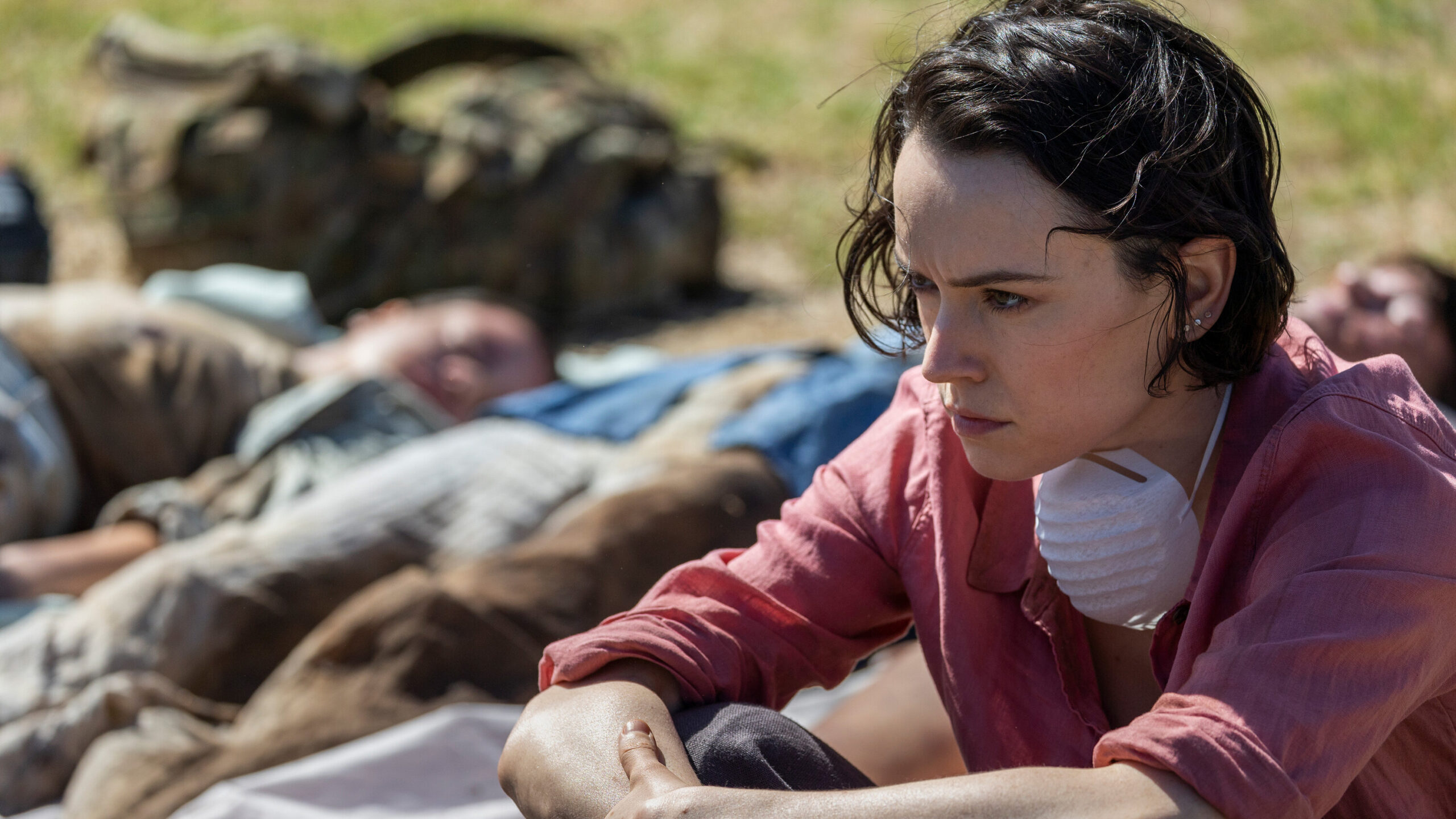
Hey there everyone! Welcome back to Movie Soapbox, the little corner of the internet that only you and I and that guy sleeping in the corner over there know about. This is the place where we find underappreciated indie films and we make sense of them. Today? We are doing a deep dive on We Bury the Dead, a movie so quietly devastating and so determinedly mismarketed that the people who most need to see it are the ones most likely to bounce off the first twenty minutes and go watch something blow up instead.
Fair warning before we go any further: everything from this point forward is a full spoiler walkthrough. The ending, the twist, Riley, the baby, all of it. If you haven’t seen the film yet, bookmark this, go watch it, and come back. You’ll want the context. If you have seen it and you’re sitting here with that particular look on your face, the one that means you felt something you can’t quite name yet, then you’re exactly where you need to be. Let’s work through it.
The Making of We Bury the Dead
So here is the thing you need to understand before a single frame of this film makes sense to you: Zak Hilditch came up with a story about a woman crossing a zombie-infested island to find her dead husband, and at some point in the development of this project, somebody in a room somewhere had to look at a script full of quiet grief and slow motorcycle rides through burned countryside and a scene where a woman helps a corpse dig graves in silence, and they had to decide whether to let that be the movie. At the budget and cast tier We Bury the Dead operates in, with a name like Daisy Ridley attached, the gravitational pull toward conventional genre delivery is enormous. You can feel in every frame the version of this film that didn’t get made, the one with more running, more biting, more clean three-act propulsion. The fact that what exists on screen is this slow and this sad and this insistent on its own rhythms tells you something about how much someone fought to keep it that way. Films at this level don’t accidentally stay weird. Somebody made a decision every day of the shoot to not fix it into something more commercial, and you should appreciate that before you decide to call it boring.
We Bury the Dead Movie Walkthrough
Now. The setup. The United States detonates an experimental electromagnetic pulse weapon off the coast of Tasmania, accidentally, and five hundred thousand people drop dead in an instant. Hobart is gone. The island is a ruin. And then, because the film has more on its mind than a standard body count, a percentage of those dead start waking up. Not all of them. Not the terrifying tidal wave of undead you’ve been trained by twenty years of zombie cinema to expect. Just enough. Just enough to make the living wonder if the people they lost might not actually be gone forever, which is, if you think about it, a specific kind of cruelty the film is going to spend ninety-four minutes unpacking.
The Australian government organizes body retrieval units. Volunteers go into the quarantine zone to locate and tag corpses, to give families something to bury, to provide closure. Ava Newman (Daisy Ridley) signs up. She’s an American physiotherapist and her husband Mitch was at a business conference in Woodbridge, on the southern end of the island, when the pulse went off. The authorities have told her no one survived. She does not believe them, or she does believe them and can’t make herself accept it yet, and the film is smart enough to understand that those two things are not the same.
Ava gets assigned to the northern sector, two hundred miles from where Mitch was. She’s partnered with Clay (Brenton Thwaites), another volunteer carrying his own weight, his family’s conviction that he is fundamentally selfish, the need to prove that wrong through one large unambiguous act. They find a motorcycle. They abandon their unit. They ride south.
What this film is, in its bones, is a road trip through a marriage that was already dying before the world ended. The flashbacks come in pieces: infertility, the rift it opened between Ava and Mitch, the affair Ava had, Mitch finding out, the last conversation they had being the worst one, the kind you can’t unhear. Ava isn’t crossing a zombie-infested wasteland because she thinks Mitch is alive. She knows he’s dead. She’s crossing it because she needs to apologize. Because she cannot metabolize the idea that the last thing she said to her husband was whatever she said in that fight. That’s the engine of this entire film and it has nothing to do with the undead.
Clay and Ava get attacked at an abandoned petrol station and they’re saved by Riley (Mark Coles Smith), a lone Australian soldier. He has a vehicle, he has supplies, he seems like exactly the lifeline you’d want in a collapsed world. He offers to take Ava to Woodbridge. He does not take her to Woodbridge.
He takes her to his house.
Riley’s family died in the blast. He was on the mainland, unreachable, unable to do anything. When his pregnant wife Katie reanimated, he kept her. She’s in their bed. He has other zombies chained in the shed. He’s been studying them, taking notes, building a theory: the dead who come back are the ones with unfinished business. They return because there’s something they still need to complete. By that logic, Katie came back for him. For their relationship. For their story, which Riley has decided is not finished.
He makes Ava wear Katie’s clothes. Katie’s perfume. He makes her dance with him. When she won’t remove her wedding ring, when she won’t fully disappear into the role he’s cast her in, he becomes violent.
Mark Coles Smith does something genuinely hard in this sequence. He plays Riley without a single note of villainy, no pleasure in cruelty, no awareness of his own monstrousness. Riley is a man whose grief has become load-bearing, the whole architecture of his continued existence rests on it, and Ava threatens that architecture just by being a person instead of a projection. His logic almost tracks until you realize where it leads. That’s the 28 Days Later move this film is making, and it earns it. The infected in that film were the context. The military compound was the horror. The zombies were predictable, you see them, you run or you shoot, transaction complete. The humans in that compound made choices. Choices about who suffers and why and what they were owed by the apocalypse. Riley made a choice. He looked at a world without rules and decided it meant he could take what he wanted to reconstruct what he lost. That’s the monster. Not the chained dead in the shed.
Ava kills Riley. She escapes in his car. And before she does, she sees Katie beginning to move more deliberately.
On the road, Ava stops at a camper van. Outside are the bodies of a family, father, mother, two children. In the night, the father wakes up. He picks up a shovel. He starts digging.
He’s digging graves for his family.
He doesn’t speak. He doesn’t attack. He doesn’t do anything except the one thing he came back to do. Ava helps him. They dig together in silence. When it’s done, when the family is in the ground, the father steps into the last grave and looks at her. She understands. She kills him. A mercy. A completion. He needed to bury his people and then be buried with them, and now he is, and Riley’s theory was correct but his application of it was the whole catastrophe.
Ava reaches Woodbridge. She finds the resort. Mitch is dead, and he did not reanimate, and there is no final conversation, no apology delivered, no version of closure that resembles what she needed. And then the detail that lands like a flat stone in still water: two wine glasses in his hotel room. A woman’s corporate ID. His wedding ring on the nightstand. A do-not-disturb sign. Mitch was having an affair too. While Ava was destroying herself with guilt over her betrayal, he was doing the same thing. Their marriage was already a ruin before the pulse went off. They were both already gone.
Some conversations don’t get a conclusion. Some relationships end in the middle of a sentence and you live with that or you don’t, and the apocalypse doesn’t change the math, it just makes the incompleteness permanent. Clay finds her sitting with Mitch’s body. They give him a Viking funeral, fire on the water. It is not the closure Ava wanted. It’s the only closure available, and the film is honest enough to hold those two things at the same time without collapsing one into the other.
On the journey back, they find Katie again. Riley’s pregnant zombie wife, wandering through the wilderness. She went into labor. The baby was born. The baby is alive. A living child from a dead mother, and Katie walks away from the infant without a second glance, because her unfinished business is complete. She didn’t come back for Riley. She came back to deliver the child. That was the whole of it. Riley had built an entire architecture of need and fantasy around a woman whose only remaining drive was a biological imperative that had nothing to do with him.
Ava picks up the baby.
That’s the ending. Not resolution exactly, nothing so clean. But something. The grief is named. The guilt is no longer frozen in the posture of denial. A child is alive in a dead world and someone is holding it. The film ends on that image and it earns the weight it’s asking that image to carry.
The Theories to Explain the Movie We Bury the Dead
Theory #1 – The Literal Theory
The competing reads on what this film is doing mostly organize around Riley’s theory. One camp takes it literally: the dead return for specific purposes, their reanimation is purposeful, almost spiritual, the zombie apocalypse in this world is a grace period the universe extends to the unfinished.
Theory #2 – The Projection Theory
The other camp reads it as projection, Riley’s theory is what a broken man tells himself to make his captivity of his dead wife feel like love, and the father digging graves and Katie delivering her child are coincidences that grief-saturated survivors pattern-match into meaning. The film doesn’t resolve this and it doesn’t need to. Both readings produce the same emotional outcome: the dead are not the threat, the living who refuse to let go are the threat, and the most human thing in this film is a corpse digging a hole in the dark.
The Moviesoapbox Preferred Reading of We Bury the Dead
My read is the literal one. I think Hilditch built a world where the dead genuinely do return with a residual drive toward completion, and I think that makes the film’s argument sharper rather than softer. Because if the zombies have one last real thing they need to do, then Riley’s horror is even more specific: he looked at his wife’s final drive, which was to bring their child into the world, and he decided it was about him. That’s not grief. That’s the thing grief turns into when it goes feral. The father zombie was more present in his love for his family in death than Riley managed to be in his obsession. That contrast is the whole film.
Here’s the closing thought, and it’s the one that makes We Bury the Dead worth defending in whatever conversation you get into about it: the electromagnetic pulse didn’t break anything that wasn’t already cracked. Ava and Mitch’s marriage was crumbling. Clay’s relationship with his own sense of worth was already a problem. Riley’s inability to release what he loved was already in him before Katie died, the apocalypse just handed him a situation where he could act on it without consequences. The undead world is just the existing relational wreckage made permanent and visible. That’s the move. And the fact that a zombie film this quiet and this specific about human failure got made at all, with a cast that could have demanded something louder, is its own small miracle. The version of this film that nine more rounds of studio notes would have produced doesn’t have that father digging in the dark. Somebody kept it. Good.
That’s the show. We’ll see you on the next one.