
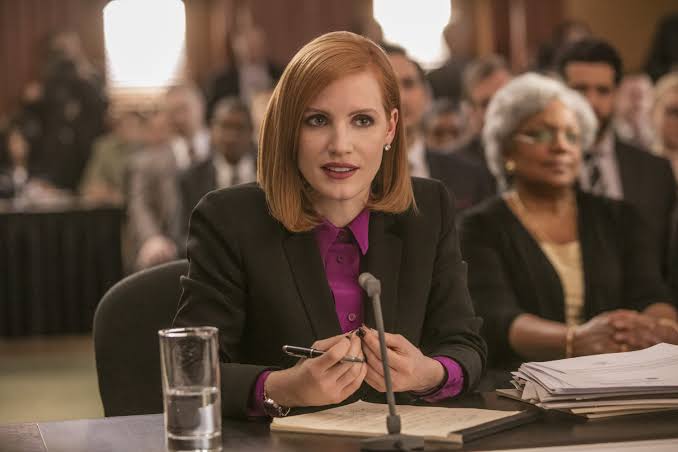
Hey there everyone! Welcome back to Movie Soapbox, the little corner of the internet that only you and I and the guy in the back who’s been rewinding the same Senate hearing scene for forty minutes know about. This is the place where we find underseen, undervalued films and we actually make sense of them, not just describe them, make sense of them. Today we are doing a full deep dive on Miss Sloane, a movie so methodically constructed, so patient in its deception, that by the time it shows you what it actually is, you’ve already been played just as thoroughly as every suit in that Senate chamber.
Alright. From this point forward we are inside the movie, all the way inside, every card on the table. If you haven’t seen Miss Sloane yet, I want you to stop reading, go find it, watch the whole thing, and then come back, because nothing I’m about to tell you will mean anything unless you’ve already felt the floor drop out from under you at least once. The ending only works if you earned it. Go earn it. The rest of you, pull up a chair.
The script for this movie was written by a man named Jonathan Perera, who had, at the time he wrote it, never written a produced film in his life. He was teaching English in South Korea. He had a law background, which helps, but barely, because what he did here isn’t really a legal thriller, it’s a magic trick disguised as a political drama disguised as a character study, and pulling off three layers of misdirection on your first swing is not a law school skill. What you need to understand before we get into the mechanics of the ending is what kind of film this wanted to be, because a first-time writer with no producing relationships and no studio track record writing a Washington D.C. thriller with a gun control backdrop on spec is writing something that, in the normal course of events, gets three rounds of notes telling him to pick a lane, simplify the timeline, and give the protagonist a clearer emotional journey that doesn’t require a diagram to follow. The fact that the non-linear structure survived, that the long con at the center of the plot survived, that the movie retained its willingness to let you feel genuinely lost for ninety minutes before it pays everything off, that survival is not an accident of the marketplace. Someone, somewhere in the chain between a spec script and a Jessica Chastain vehicle, kept the suits from flattening it. You can tell, because the film still has teeth. Films that get fully committee-processed stop biting.
So. What is Miss Sloane actually about, and what actually happens at the end of it.
Miss Sloane Movie Deep Dive Walkthrough
The movie opens at the conclusion, with Elizabeth Sloane in front of a Senate investigation committee, talking to her lawyer, and delivering the thesis of the entire film in the first two minutes: lobbying is about anticipating your opponent’s moves and playing your ace after they play theirs. You hear that and you think it’s characterization. It’s not. It’s the instruction manual. She is telling you exactly how to watch the next two hours. The movie then moves backward seven months to Sloane’s tenure at Cole, Kravitz and Waterman, where the gun lobby comes to the firm hoping to hire her to fight against the Heaton-Harris bill, a piece of legislation that would expand background check requirements. Sloane refuses. She’s contemptuous about it. The head of Cole wants the business anyway, badly enough to seriously consider pushing her out. Meanwhile, a smaller firm, Peterson Wyatt, comes to Sloane with the opposite pitch: come fight for Heaton. And something clicks behind her eyes.
This is the moment the long con begins, and the movie doesn’t tell you that. It lets you think you’re watching a conversion narrative, a mercenary lobbyist who decides to fight for something she actually believes in. That reading is available and the film supports it on the surface. But the real architecture is something colder and more elegant. Sloane pulls Jane aside, a young associate at Cole, smart, principled, someone Sloane clearly respects, and she tells Jane to stay. Not to come with her when she defects to Peterson Wyatt. Stay at Cole. Jane agrees. They draft paperwork together for a dodgy congressional junket, a trip offered to a congressman as an inducement on a Palm Oil bill. It’s a bribe. Sloane’s handwriting is all over it. She leaves the paperwork where it can be found. Then she leaves for Peterson Wyatt, taking most of her team but not Jane, and she proceeds to run the loudest, most aggressive, most legally questionable campaign for Heaton-Harris that Washington has ever seen. She bugs senators. She uses ex-NSA surveillance contractors. She pushes Esme Manucharian, a gun-violence survivor, into the national spotlight, hard enough that it nearly gets Esme killed. She does all of this because she knows what Cole is going to do in response. They are going to come after her personally. And she needs them to.
Cole digs through the old files looking for anything that can blow up Sloane’s ethics standing. Jane finds the Palm Oil junket paperwork with Sloane’s signature. Cole uses it. They also, because they cannot resist, bribe Congressman Sperling into convening a Senate investigation into Sloane’s conduct, which is the hearing we’ve been watching from the beginning of the film. Sloane is marched in front of the committee. The male escort she’d been using for stress relief gets paraded out. The ethics violations get read into the record. Everything is going sideways. Their vote count for Heaton is collapsing in real time. She looks finished.
And then the committee invites her to make a final statement.
Sloane acknowledges that she broke ethics codes. She acknowledges the collateral damage, to her team, to Esme, to people she was supposed to protect. And then she discloses that she had surveilled key members of Congress specifically to catch Cole’s people in the act of bribing them into targeting her. She has the tape of George DuPont of Cole handing a bribe to Congressman Sperling to convene this exact hearing. The hearing that was supposed to destroy her is the trap. The committee explodes. Sperling is done. Cole’s entire operation is exposed. Heaton-Harris passes.
Jane walks in, hands in her notice, the letter reads across two pages: page one, a conviction lobbyist can’t only believe in her ability to win. Page two, for services rendered Peterson Wyatt offers you zero dollars. Cole, Kravitz, and Waterman pursued Sloane so hard, dug so deep into those old files, and handed her the weapon that finished them. Jane stayed, as agreed, and fed them exactly what they needed to find. The bill passes because the opposition destroyed themselves following the breadcrumbs Sloane left for them.
That two-page note is doing a lot of work in a small space. Page one is a callback to a line Sloane gave Peterson Wyatt’s head when he was pitching her on the campaign: a conviction lobbyist never cheats, she exposes cheaters. Sloane didn’t just believe in the bit. She closed it. She actually passed the bill. Page two is the cleanest possible summary of the entire con: Cole’s operation was the mechanism of their own defeat, and Cole gets no credit for that, no settlement, no gratitude, nothing. You helped us win by trying to destroy us. The check is for zero.
The Ending of Miss Sloane Movie Explained
Now let me put the chronology flat on the table, because the film’s non-linear structure does you no favors and there are several things that only register as intentional once you see them in order.
Sloane and team are at Cole, Kravitz and Waterman. The gun lobby comes to Cole wanting Sloane to fight against Heaton. Sloane refuses and humiliates them. Cole’s head is furious about losing the business. Peterson Wyatt pitches Sloane on the pro-Heaton campaign. Sloane has her epiphany, sees the whole architecture of what’s possible. She pulls Jane aside privately and they agree: Jane stays, Sloane goes, they construct the Palm Oil junket paperwork together with Sloane’s handwriting visible on it, a deliberate artifact, planted where a motivated opponent will eventually find it. Sloane defects to Peterson Wyatt, takes most of the team, begins the Heaton campaign aggressively enough to make herself a target. Cole assigns Jane to dig for ethics violations. Jane finds the junket paperwork. Cole uses it. Meanwhile, Sloane’s surveillance operation captures the DuPont-to-Sperling bribe on video. The hearing convenes. Sloane walks in with the tape. The committee falls apart. Sloane serves four to six months for the ethics violation on the travel inducement, not five years for perjury. She accepts the shorter sentence because she never discloses that the junket was designed as bait. She pays a real price. The bill passes anyway.
Miss Sloane Movie Theory Explanations
Miss Sloane Movie Theory #1
The first reading is that this is a movie about gun control that uses the heist structure to make the advocacy palatable to a broader audience. On this read, the policy content matters, the Heaton-Harris bill is the real subject, and Sloane is a vehicle for arguing that the gun lobby is beatable if someone is ruthless enough and smart enough to expose how it operates. The driver’s license argument that comes up in the film, we require licenses to operate cars, why not licenses for deadly weapons, is on this reading not just rhetorical decoration but the actual thesis.
Miss Sloane Movie Theory #2
The second reading is that the policy content is essentially irrelevant, the movie could have been about any sufficiently high-stakes legislative battle, and the real subject is the pharmacology of winning. Sloane isn’t changed by the cause. She’s addicted to the game. The Heaton campaign is just the most challenging board she’s ever found. On this read, the moment that registers most is the attack on Esme, Sloane exposing Esme’s history as a shooting survivor in a nationally televised debate without Esme’s consent, nearly getting her killed in the process. That’s not a cause lobbyist. That’s someone for whom the mission is the only thing that matters, and the people attached to it are assets to be deployed.
Miss Sloane Movie Theory #3
The third reading, and the one that holds the most structural weight, is that the movie is about the difference between a system and a conscience. The system of Washington, the bribery, the committee investigations as political weapons, the ethics violations as transactional currency, operates without morality, only leverage. Sloane beats that system by learning its grammar better than the people who built it. But the final scene, Sloane not taking her pills before the hearing, Sloane acknowledging real culpability for Esme’s near-death, Sloane accepting jail time she could arguably have avoided, suggests something cracked open in her that the plan didn’t account for. She won. She also stopped being the person who would have thought the cost was acceptable. Whether that’s growth or damage is left genuinely open.
Moviesoapbox’s Personal Take on Miss Sloane Movie
My read is the third one, and I’ll tell you exactly why. The Jane structure is the key. Sloane could have run this entire con without Jane. She had the surveillance operation, she had the parliamentary leverage, she could have found another way to get the junket paperwork into Cole’s hands. She didn’t need a trusted person on the inside. She chose to involve Jane, which means she chose to involve someone she actually cared about in a plan that would require Jane to spend months pretending to work against her. That’s the movie’s tell. The woman who treats everyone around her as an asset doesn’t build in a human variable like Jane unless some part of her needed a witness. Someone who would know, at the end, what the cost was and what it was for. The zero-dollar letter isn’t just a legal document. It’s the only acknowledgment Sloane gets that someone else saw the whole board and understood what she was doing. In a movie full of people who were played, Jane is the one person who was trusted. That’s not a tactical decision. That’s the only honest relationship in the entire film, and Sloane engineered it to survive the con intact.
She won the vote. She’s going to prison for a few months. Esme almost died because of her. The bill passed anyway, because she was willing to pay a price that the machine on the other side of the table never even considered she might be willing to pay. That’s what the factory version of this movie doesn’t understand, the version that gets five more rounds of notes and a cleaner third act and a protagonist whose moral redemption arrives on schedule. The reason Miss Sloane works is that the price is real and the win is real at the same time, and the film doesn’t reconcile them for you. A first-time writer sitting alone in South Korea understood that those two things could coexist on screen without resolution. Somebody in the pipeline was smart enough to leave it alone. We got lucky.