
Hey there everyone. Welcome back to Movie Soapbox, the little corner of the internet that only you and I and whoever that is asleep in the back booth know about. This is the place where we dig up the films that got buried, or almost never got made, or got made in spite of everything the system could throw at them, and we figure out what they were actually trying to say. Today we are doing a full deep dive on Kontroll, a 2003 Hungarian film shot entirely underground, in the actual Budapest Metro, about a ticket inspector who may or may not be murdering people, may or may not be one person, and is definitely, absolutely, coming apart at the seams in ways the film takes its sweet time admitting to you.
Before we go any further, understand that everything below this line is a spoiler. Not a gentle, soft-pedaled spoiler warning where I pretend you might be able to read half of it and stop, but a full, scene-by-scene, theory-forward dismantling of this film that only works if you already know how it ends, or you’ve decided you don’t care. If you haven’t seen it yet, go watch it, it’s on a handful of streaming platforms and it’s ninety minutes of your life that will not feel wasted. Then come back. Mike will be here.
Kontroll Movie Walkthrough Deep Dive
What you need to understand before anything else about Kontroll is what kind of film it was positioned to be versus what it actually became, because that gap tells you everything about why it survived. A first feature from a young Hungarian director, Nimród Antal, shot guerrilla-style in the Budapest Metro with the transit authority’s permission only because they apparently didn’t read the script too carefully, this is the kind of project that exists in the exact window between no-budget obscurity and just-enough-buzz-to-matter. Films at this budget and profile tier, shot in a single practical location with a cast nobody outside their home country has heard of, get acquired by distributors who then spend six months trying to figure out how to market them before quietly dumping them with no campaign. The fact that Kontroll got a real festival run, Cannes sidebar, the FIPRESCI prize, and eventually found an international audience is not a given for a film like this. It is the exception. Antal made something that was too visually specific and too tonally confident to be easily ignored, and that specificity is usually what saves a film from the acquisitions-table death that gets most of its peers. You can tell when a director knew exactly what he was doing and the film moved fast enough that nobody had time to talk him out of it.
So. The Budapest Metro. The entire film takes place underground. You will not see natural light for the full running time, not really, not until the final seconds, and even then you could make a reasonable argument that what you’re seeing is not sunlight. The premise sounds procedural at first, which is why people bounce off the opening ten minutes and assume they’ve loaded the wrong file. Bulcsú is a ticket inspector. He and his team ride the Metro, check passengers for valid tickets, deal with people who haven’t paid, deal with each other, deal with a rival inspector team, deal with the grinding, fluorescent, subterranean monotony of doing this job every day, except Bulcsú is not going home at the end of his shift. He is sleeping on the platforms. He is waking up on stopped trains. He has disappeared entirely into the Metro system in a way that has ceased to be a quirk and become something more like a symptom.
The Metro is also getting hit with a string of suicides. People going onto the tracks. Management is asking the inspectors to watch for anyone who looks like they might be about to do it. And somewhere in the tunnels, there is a hooded figure who is not waiting for people to jump. The hooded figure is pushing.
Bulcsú sees this figure. He tries to catch it. He can’t, because every time he gets close, something happens, a flashback, a nightmare fragment surfacing at the wrong moment, and the figure is gone. His team notices he’s degrading. He goes missing during night shifts and can’t account for the gaps. The rail run sequence, where Bulcsú and a rival named Gonzó race through an active Metro tunnel ahead of an incoming train, functions in the film as a kind of insane bravado set piece, but watch what it’s doing structurally: it’s showing you a man who has no fear of being killed by a train. A man who has made peace with the idea of the tracks taking him. That detail is load-bearing and the film plants it early and then politely never mentions it again, trusting you to carry it.
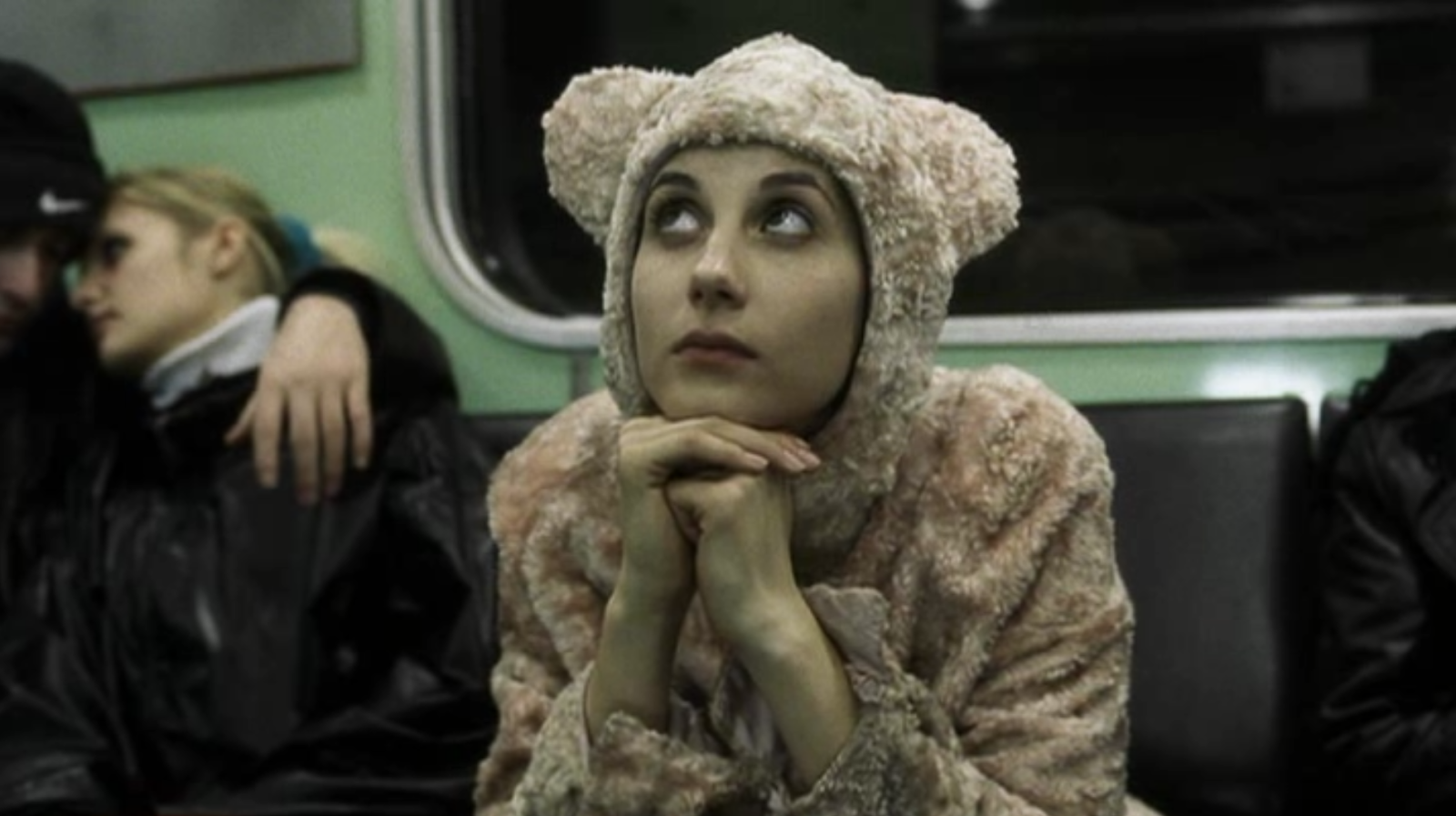
There is also Szófi. She rides the Metro in a bear costume. She doesn’t have a ticket. Bulcsú keeps encountering her and he keeps not citing her and eventually they begin something that functions as a connection, the one human thread he seems to be maintaining. She tells him she rides without a ticket. She shows up again at the end, dressed as a butterfly this time, and she is the one who leads him up out of the Metro and toward whatever the surface represents. Hold that.
Now. The hooded figure. You will notice, if you are watching carefully, a birthmark on the killer’s hand. You will then notice the same birthmark on Bulcsú’s hand. You will notice that Bulcsú sleeps in a fetal position on the platform and the killer is shown sleeping in that same fetal position in multiple tunnel locations. You will notice that every time Bulcsú is confronted with what he knows about the killer, he withholds information he should not have. The clothes are the same. The gait is the same. At a key moment the film cuts from Bulcsú face to face with this figure directly to a shot of Bulcsú staring at himself in a mirror. The film is not being subtle. It doesn’t need to be. The argument is not that Bulcsú is the killer in some clever twist sense. The argument is that the killer is a piece of Bulcsú, the part of him that the Metro has fed and the daylight has been starved out of, and the movie has been telling you this through visual grammar from almost the first frame.
Kontroll Movie Theories Explained
Three readings exist for what is actually happening in this film and they are not mutually exclusive, which is the honest thing to say about them.
Kontroll Theory #1 –
The first reading: the killings are real, Bulcsú is genuinely a dissociated murderer operating in blackout states, and the film is a psychological thriller about a man who has lost the thread between his conscious and unconscious behavior. The evidence is concrete, the birthmark, the sleeping positions, the knowledge he shouldn’t have, and the film gives you enough to sustain this reading without strain.
Kontroll Theory #2 –
The second reading: the killings are real but Bulcsú is not the killer. The hooded figure is a separate person, possibly another Metro worker, and Bulcsú’s resemblance to him is the film using visual doubling to make a point about how thin the line is between someone who catches the falling and someone who causes the fall. This reading is harder to hold because of the mirror cut, but some viewers land here and stay.
Kontroll Theory #3 –
The third reading, and the one that opens the film up the most: none of this is happening. Not the killings, not the job, not the tunnels in any literal sense. The entire film is a sustained metaphor for an internal psychological landscape. The Metro is the subconscious. The inspectors, checking tickets, enforcing rules, demanding that people have paid for the right to be where they are, are the mechanisms of self-judgment. The suicides are the impulses Bulcsú cannot stop. The killer is the part of himself he cannot integrate or confront. And Szófi, the girl in the animal costume who rides without paying and whom nobody can quite pin down, is the part of him that might still be capable of something unguarded and real. The bear becoming a butterfly is not an accident. That is the film telling you what it thinks growth looks like, a thing that was armored and unknowable becoming something that can move toward light.
The final sequence seals the third reading for me. Bulcsú rail-runs with the hooded figure during the Metro workers’ office party, and the figure goes into the tunnel and does not come back out. Bulcsú has outrun his own shadow, or outlasted it, or exhausted it, and then Szófi is there, and they go up. Together. The camera, which has spent the entire film pointed downward and inward and fluorescent, finally moves toward an exit. You could read that as hope or you could read it as death, depending on how dark you want to go, but Antal shoots it warmly enough that despair feels like the wrong conclusion.
Moviesoapbox’s Take on the Movie Kontroll
My read, planted here without apology: Kontroll is a film about a man who retreated so far into a controlled, enclosed, rule-governed internal world that he lost the capacity to surface, and it’s about the one connection that gives him a reason to try. The killer is real in the way that the worst version of yourself is real, which is to say it has weight and it has consequences and you cannot simply decide it doesn’t exist, but it can be run to exhaustion if you are willing to go into the dark after it. The Metro is his mind. The ticket inspection is control, the management of self, the demand that everything in him justify its presence. And the whole architecture collapses the second you understand that Bulcsú has not been going home because there is no home to go to outside his own head.
This film came out in 2003 and still does not have the audience it deserves, which is what happens to films that refuse to explain themselves in the trailer. Nimród Antal went on to direct Vacancy and Predators for studio money, which is the tax that Hollywood levies on any foreign director who shows enough command of genre to be useful to them. Those are competent films. Kontroll is the film he made before anyone could tell him what it needed to be.
If You Liked Kontroll…
The Captain (2017) – A man assumes a false identity and descends into darkness. Same European underworld energy, same examination of what happens when nobody’s watching.
The Night Eats the World (2018) – One man alone in a building that used to be full of life, building routines inside the void. Same existential isolation wearing a genre costume.
The Wave (2019) – A corporate lawyer takes a trip that dissolves the membrane between his life and something underneath it. Same hallucinatory atmosphere Kontroll builds in those tunnels.