
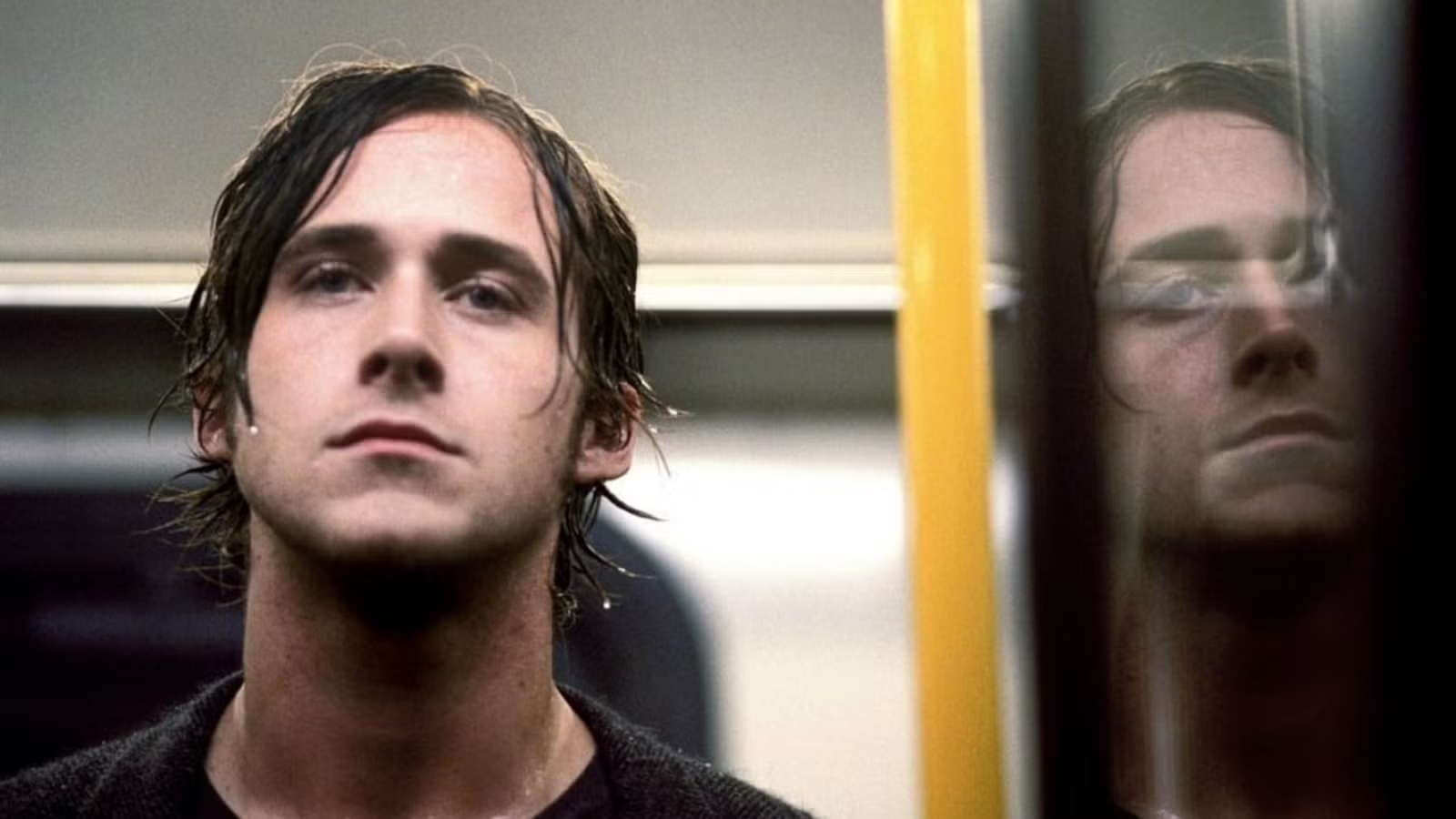
Hey there everyone! Welcome back to Movie Soapbox, the little corner of the internet that only you and I and that guy sleeping in the corner over there know about. This is the place where we find underappreciated indie films and we make sense of them. Today? We are doing a deep dive on Stay, a 2005 Marc Forster film so quietly, deliberately broken that most of the people who walked out of it in theaters thought the projector was malfunctioning. It was not malfunctioning. Every stutter, every impossible loop, every dead person standing in a lit kitchen, every repeated piano and lost balloon, all of it was earned and intentional. The movie just never got a fair shot to explain itself.
Before we go any further: this post goes all the way to the bottom of the river. Every major plot point, every theory, the ending in full. If you have not seen Stay and want to go in clean, stop reading, find a copy, come back. I will be here. The movie deserves your full attention before someone else describes it to you.
Still here? Good. Let’s go.
Stay Movie Deep Dive Walkthrough Spoilers and All
The film opens on a car wreck. A bridge. Night. Ryan Gosling’s Henry Letham sitting in the middle of a road, and then just, walking back into New York City like a man who misplaced something. Within sixty seconds the movie has already told you the truth and you missed it, because the movie is counting on you to miss it, and the machinery of the whole thing is built on that gap between what you are watching and what is actually happening.
What Marc Forster built here is a film that is genuinely trying to do something rare, which is represent the internal architecture of a dying mind not through metaphor or symbol but through the literal grammar of cinema. Dissolves that skip. Extras who repeat in different scenes. Stairwells that connect floors that cannot geometrically connect. The film does not signal these things as glitches, it presents them as normal, because inside the consciousness generating them, they are normal. You are not watching a reliable narrator. You are watching an unreliable universe.
Now. A word about what this film almost was, and how you can read its survival on screen like a scar map.
A film like Stay arrives at a studio with a script, a director with a legitimately surprising track record, Ewan McGregor in the lead, Gosling pre-Half Nelson but already with the heat on him, and Naomi Watts, and still somehow ends up with a $50 million budget and a wide release that pulls $8 million domestic. You know what that release pattern tells you? It tells you someone panicked in post. A film this formally committed to its own logic, this allergic to conventional narrative resolution, should not have been given 2,500 screens. That was a studio deciding to play it like a mainstream thriller and getting punished for the mismatch. The marketing team sold The Sixth Sense. The movie delivered Alain Resnais. Those are not the same audience and no amount of test-screening reshuffling was going to bridge that gap. The miracle is that the cut that exists is as coherent and uncompromised as it is.
So the story. Ewan McGregor plays Sam Foster, a psychiatrist covering patients for a colleague out on medical leave. One of those inherited patients is Henry Letham (Gosling), who announces in their first session that he intends to kill himself at midnight on his 21st birthday, which is Saturday, three days away. Henry is an art student. He is painting obsessively. His paintings are everywhere in his apartment and they are extraordinary and wrong in the specific way that grief produces extraordinary wrong things. Woven alongside Henry’s storyline is Sam’s anxiety about his girlfriend Lila (Watts), a former patient who survived a previous suicide attempt and has recently stopped taking her medication.
The film runs these two tracks simultaneously. Henry getting closer to Saturday. Sam getting more destabilized, seeing things repeat, losing the seam between one moment and the next. A grand piano craned up the side of a building, twice. A boy with a balloon, losing it, again. A chess game that continues across discontinuous spaces. The film’s texture is fraying at the edges in ways that feel just slightly off, the kind of thing you notice in your peripheral vision and lose when you look directly at it.
And then the film keeps doing this thing where Sam tracks down Henry’s family members, only everything about them is wrong. Henry has been telling Sam his parents are both dead. Sam finds Mrs. Letham anyway. She seems functional, normal, until blood begins running from her temple with no apparent cause and she is standing in an apartment that is completely empty, hollow, staging-only. He finds Henry’s father, who is blind and does not recognize Henry’s name. Until Henry, near the end of the film, touches his father’s eyes and the blindness lifts. These are not plot holes. The film is not being careless. Everything broken about Henry’s family in the film is being generated by Henry’s broken recall of them. His father’s blindness is not literal blindness. It is Henry’s guilt rendering his father unable to see him.
The film also drops one of the loudest thematic flags I have ever watched an audience walk past. Midway through, Freud’s burning boy story gets put on the table. A father dreams his dead son appears to him and says, “Don’t you see that I’m burning?” And Freud’s reading is that the dream is the psyche’s mechanism for staying asleep, for metabolizing a piece of reality it cannot yet absorb awake. The father’s mind constructs the dream because waking up to the literal truth, the candle has tipped over, his child’s body is on fire in the next room, is less bearable than the dream in which the son is simply burning and speaking. The dream prolongs the moment of not-yet-knowing. That is exactly what the entire film is. Henry’s mind prolongs the moment of not-yet-knowing what he has done.
The repeating images are the tells. Henry speaks Sam’s dialogue before Sam speaks it. The fortune cookie says what Henry already said. The looping staircases. These are not time travel mechanics, not parallel universes, not a supernatural premise. They are the texture of a mind that is cycling through the same moment of trauma, the same branch-point, over and over, because it cannot find the exit.
Then the ending arrives and the film simply tells you what it is.
We cut to the bridge. The night of the accident. Sam and Lila are among the first responders who reach the wreck. The passengers in the car are dead, Henry’s family, his fiance. The boy with the balloon and his mother are bystanders on the bridge. Sam and Lila find Henry still alive, barely, and Sam leans in close and says, “Stay with me. Is your name Henry? Stay with the sound of my voice.”
The entire film has been happening inside Henry’s mind in the minutes between the accident and his death. Sam is not his psychiatrist. Sam is the stranger on a bridge who is trying to keep him present. Lila is Sam’s real girlfriend, also present at the crash, also not who she appeared inside Henry’s constructed world. Every character in the film has been Henry’s dying mind recruiting the people immediately around him and assigning them roles in a reality it was building in real time. A reality where someone was trying to save him. Where the ring he lost, the engagement ring he had for his fiance who is now dead, had been found and kept safe. Where there was a Sam whose whole job was to hold Henry here.
The exchange near the film’s end, the one that reads like bad dialogue until it reads like the only dialogue:
“You are, you’re real. You are trying to save me, but I just gotta wake up.”
“You are awake.”
“Look around you, if this is a dream then the whole world is inside it.”
Henry is not speaking to Sam-the-psychiatrist. He is speaking to his own mind, which has been trying to convince him to stay present. The whole world is inside it because the whole world Henry built is inside his mind. And he knows it. Now the theories, because the film sustains more than one reading and it earns all of them.
Stay Movie Theories to Explain It
Stay Movie Theory #1 –
The first is the literal read: a dying man’s mind constructs a reality in which someone is trying to save him, because the actual trauma is too catastrophic to sit with directly. His guilt, “Please forgive me” scrawled on every wall, is metabolized through this constructed world where he has a chance to choose differently. The literal read is clean and sufficient and completely satisfying.
Stay Movie Theory #2 –
The second is the theological read, and if you have seen Jacob’s Ladder you have already built half of this yourself. That film, also a man dying violently, builds a world in which demons and angels are contesting his soul, stripping away the attachments of his life one by one until he can let go. Stay is doing something adjacent. The question the film is actually asking is not whether Henry survives the accident. That question is settled before the first frame. The question is whether Henry’s soul can release the guilt long enough to die without the full weight of it. “There’s too much beauty in the world” against “please forgive me.” That is the contest. Every scene is a round of it.
Stay Movie Theory #3 –
The third read is Freudian, and the film explicitly gives you the key. Henry’s dying mind is doing precisely what Freud’s dreaming father’s mind did: building a present-tense experience in which the wish is represented as fulfilled. The wish is that someone is coming. The wish is that the ring was not lost. The wish is that his family is not all dead in the car behind him. The film renders these wishes as scenes, as perceived reality, because that is what a dreaming psyche does with the things it cannot absorb directly.
All three of these readings are true simultaneously, which is not a failure of the film to commit, it is the film understanding that a dying mind would not organize its final experience around a single coherent metaphysical framework. It would use every available system at once.
Movie Mike’s Movie Soapbox Perspective:
My read is the Freudian one layered inside the theological one. Henry is dreaming in Freud’s sense, building present-tense wish-fulfillment to stay in the moment before knowing. And what he is building is an angelology, a figure who exists only to hold him here and tell him he is real and worth saving. Sam is not a psychiatrist. Sam is what Henry’s mind could manufacture, in the minutes it had, from a stranger’s voice in his ear saying stay. That is the most human thing this movie does. The people we invent to save us at the end are built from almost nothing, a voice, a hand, a name repeated, and we make them whole.
Stay died at the box office because it was sold as a thriller and it is a requiem. It cost $50 million and pulled $8 million domestic and got filed under “noble failure” by the same industry that greenlighted it. Marc Forster went on to make World War Z, which is a very different set of conversations with very different VPs in very different rooms. This film is what happens before that process fully takes hold, a director with something genuine to say and just enough cast and budget to say it, before the machine decides what it should have been instead. It did not get mangled. It got ignored, which in some ways is worse, because ignored means the conversation never happened at all.
It is happening now. That is what this is for.
Thanks for spending time in this corner of the internet. We will see you on the next one.
If You Liked Stay…
Linoleum (2022) – A life that feels slightly off, details that don’t add up, and a final reveal that reframes everything as something far more devastating than you expected.
Nine Days (2021) – An existential meditation on life and death that operates in a dreamspace just as surreal as Stay’s. The emotional weight is almost unbearable.
Buster’s Mal Heart (2016) – Fractured timelines, a man unraveling, and a reality that might be constructed entirely inside a dying mind. Same territory as Stay, different maze.